





Choose charcoal filters if you want a smoother throat feel and a muted, cooler draw. Choose standard foam (cellulose acetate) filters if you want the truest flavour and the most consistent draw for rolling machines. Neither filter makes smoking safer.
- Taste priority: Foam preserves the tobacco blend’s top notes better than charcoal.
- Smoothness priority: Charcoal softens throat harshness thanks to gas‑phase adsorption.
- Convenience priority: Foam is cheaper and easier to pack consistently in rolling machines.
If you’re after a ready‑made charcoal option, Mevius Premium Light Charcoal No.8 is a solid starting point sold through CigaretteNearby, giving you a factory‑built benchmark before you experiment with RYO charcoal tips of your own.
Key Takeaways
Charcoal filters cut gas‑phase free radicals by around 40% and soften throat feel, while foam filters preserve flavour fidelity and deliver more consistent draw for RYO rolling.
| Point | Details |
|---|---|
| Charcoal reduces gas‑phase radicals | Lab testing shows roughly 40% fewer gas‑phase free radicals with charcoal filters versus standard cellulose acetate. |
| Particulate and nicotine effects are limited | Particulate‑phase reductions are inconsistent and nicotine delivery drops only modestly except at maximal carbon loads. |
| Foam preserves flavour and draw consistency | Cellulose acetate filters act as mechanical sieves, keeping blend character intact and packing predictably in rolling machines. |
| Construction quality affects mouthfeel | Poor carbon sealing or granule distribution causes gritty draw regardless of filter type. |
| No filter makes smoking safe | Filtration changes chemical exposure but does not eliminate the health risks of combustible smoking. |
| CigaretteNearby stocks both filter types | Mevius Premium Light Charcoal No.8 offers a ready‑made charcoal option alongside standard foam‑filtered RYO stock. |
Where to check the evidence and buy filter tips
- External source: PMC review on cigarette filter utility and policy for the safety context behind filter design.
- Internal: Mevius Premium Light Charcoal No.8 product page for direct purchase.
- Internal: Tips for adult smokers before switching products for a broader switching checklist.
This article is general information, not a substitute for advice from a qualified doctor. Consult a qualified healthcare professional about your own circumstances before acting on anything here.
Table of Contents
- How do charcoal filters change the smoke you inhale?
- What do standard foam filters actually filter out?
- Does the lab evidence favour charcoal or foam?
- What trade‑offs should RYO smokers expect switching filters?
- Cigarette Nearby product comparison: charcoal vs foam options
- How do I choose the right filter tip when buying online or in store?
- Try both filter types before you commit to bulk
- Sources
- FAQ
How do charcoal filters change the smoke you inhale?
Activated carbon works by adsorption, not blocking. Gas‑phase molecules stick to the surface of the carbon granules as smoke passes through, while most solid particulates keep moving straight through to the cellulose layers around them. That distinction matters for what you’ll actually taste and feel.
Lab testing on commercial cigarettes with charcoal filters found roughly 40% fewer gas‑phase free radicals compared with standard cellulose acetate filters under machine smoking conditions, with particulate‑phase reductions far less consistent and nicotine delivery dropping only modestly. Separate emissions testing found some charcoal brands cut acrolein and formaldehyde emissions, though overall toxicity measures did not consistently decrease alongside those individual reductions.
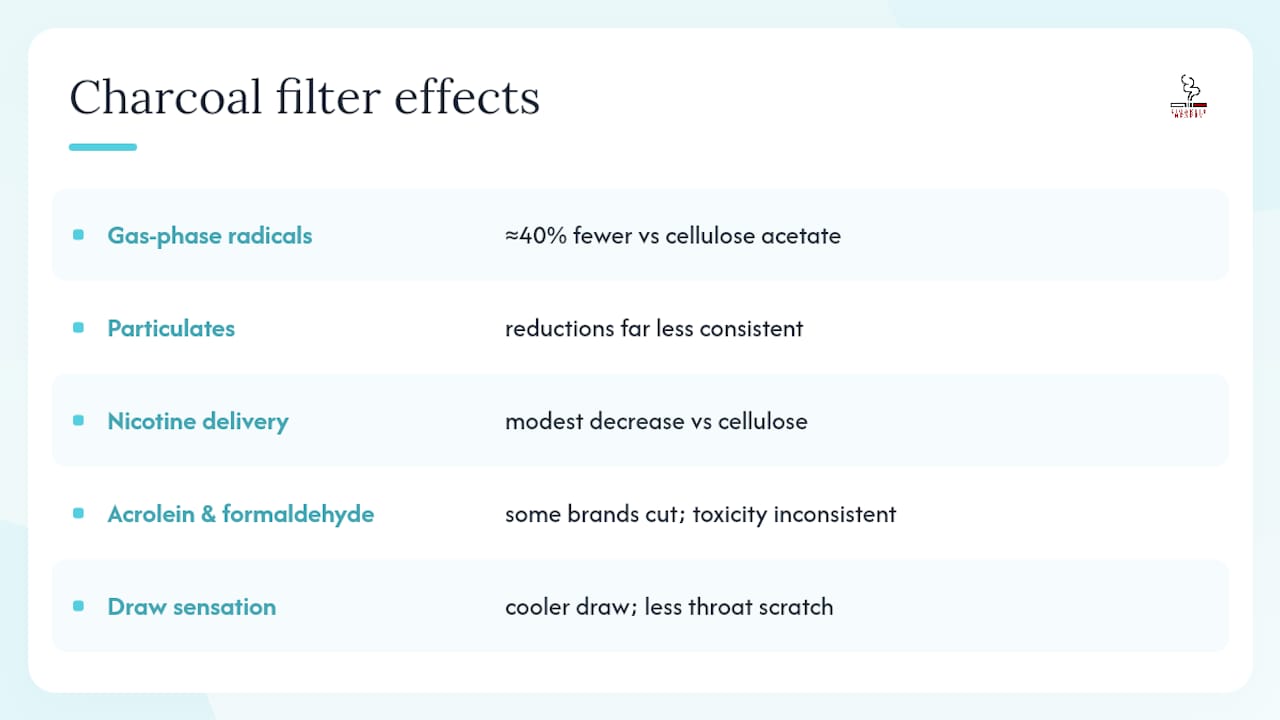
The practical result is a cooler draw and less scratch at the back of the throat, because the compounds charcoal grabs are largely the ones responsible for that raw, biting sensation.
Pro Tip: Filter performance depends heavily on construction. Even carbon distribution and tight sealing at both ends stop grit and keep draw resistance consistent between smokes, so a cheaply packed charcoal filter can taste gritty even when the carbon itself is good quality.
What do standard foam filters actually filter out?
Foam and cellulose acetate filters work as mechanical sieves. They catch tar droplets, condensate, and particulate matter as smoke is drawn through the fibrous mesh, but they don’t chemically bind gas‑phase compounds the way activated carbon does. That’s why a foam‑filtered cigarette or RYO stick tends to taste closer to the tobacco blend as the maker intended.
Foam has real advantages for everyday use:
- Consistent, predictable draw resistance from stick to stick.
- Easy to pack in RYO machines without jamming or crumbling.
- Lower cost per filter, especially useful buying in bulk.
- Preserves the blend’s top notes rather than muting them.
Manufacturing tolerances on foam and acetate tow are tight, which is part of why foam filters give such a reliably uniform mouthfeel across a whole pack.
Does the lab evidence favour charcoal or foam?
Charcoal wins clearly on one metric and only partially on others. The same commercial testing cited above measured roughly 40% lower gas‑phase free radicals with charcoal filters, but particulate‑phase radical reduction wasn’t statistically consistent across the cigarettes tested, and nicotine delivery fell by up to 33% only at the highest carbon loads used in that study. Independent guides report similar patterns, with some tests showing charcoal cutting certain irritants like p‑benzosemiquinone by about 50% while leaving broader toxicity profiles largely unchanged, according to a comparative summary of activated carbon filters.
A few caveats matter before you read too much into any percentage:
- Machine smoking protocols don’t match real‑world puffing patterns, draw depth, or frequency.
- Carbon mass, granule spread, and plug design vary between brands, so results from one filter don’t generalise to all charcoal filters.
- None of this evidence supports calling any filtered cigarette safe, only that the gas‑phase chemistry differs.
What trade‑offs should RYO smokers expect switching filters?
Expect a firmer, cooler draw with more muted flavour on charcoal, and a more neutral, easier‑rolling experience with foam. Neither is objectively “better,” they solve different problems.
- Taste: Foam keeps blend character intact; charcoal softens and sometimes flattens top notes.
- Throat feel: Charcoal reduces harshness noticeably; foam offers less protection from gas‑phase bite.
- Draw resistance: Charcoal filters often sit firmer and can feel less airy than foam of the same diameter.
- Rolling compatibility: Standard 6mm and 8mm foam filters pack predictably in most RYO rolling machines; charcoal filters can be slightly less forgiving with looser tobacco.
- Cost: Charcoal filters typically sit at a modest price premium over standard foam, reflecting the extra manufacturing step.
- Single‑use nature: Charcoal filters exhaust their adsorption capacity in one smoke and aren’t designed for reuse.
Pro Tip: Buy a small sample pack of each before committing to a bulk order. Roll two or three sticks with each filter type and pay attention to draw resistance and mouthfeel in the first few puffs. That’s usually enough to tell you which one suits your hand and habit.
Cigarette Nearby product comparison: charcoal vs foam options
CigaretteNearby stocks both filter families, and the right pick usually comes down to how you smoke rather than which is “premium.”
- Mevius Premium Light Charcoal No.8 (10 packets x 20s): factory‑built charcoal filter stick with a smooth blend profile, suited to smokers who want a cooler draw without rolling their own.
- Standard foam‑filtered RYO tips: best for everyday rolling machine users who prioritise consistent draw and want to preserve their loose tobacco’s natural flavour.
- Bulk RYO tobacco with foam tips: the most cost‑effective combination for high‑volume smokers, since foam tips cost less per stick than charcoal.
For most everyday smokers, foam remains the practical default. For an evening smoke where smoothness matters more than flavour fidelity, the Mevius charcoal option is a genuinely strong pick, and it’s a sensible first charcoal product to try before exploring loose charcoal RYO tips. Readers curious about broader draw and comfort differences across product types can also check CigaretteNearby’s piece on why some cigarettes feel smoother than others.
How do I choose the right filter tip when buying online or in store?
Decide your priority first: taste fidelity, smoothness, or convenience. Everything else follows from that single choice.
- Ask whether the filter feels consistent draw to draw, not just on the first sample stick.
- Check the diameter (6mm slim or 8mm standard) matches your rolling machine or papers.
- Look for a sample pack or small trial size rather than committing to a full carton straight away.
- Watch for red flags: dusty or gritty mouthfeel, uneven draw between sticks, or filters that crumble when handled.
- Consider disposal: charcoal filters and foam filters are both single‑use, but charcoal’s carbon core means slightly more material to dispose of responsibly per stick.
CigaretteNearby’s guide on comparing cigarettes, RYO and loose tobacco covers more of the everyday comparison points smokers weigh up before switching.
Where can you actually find charcoal and foam filters?
Both filter types are widely available online, through larger tobacconists, and via specialist RYO suppliers, though charcoal is somewhat less common on convenience store shelves than standard foam. CigaretteNearby’s online store carries both, alongside RYO tobacco to pair with either filter type.
- CigaretteNearby’s online catalogue for direct delivery.
- Local tobacconists in larger centres, where brands like Marlboro and Double Happiness often sit alongside charcoal‑filter options.
- Specialist RYO suppliers stocking loose charcoal tips in bulk.
Smokers in places like Geelong, Newcastle, or the Sunshine Coast often report charcoal options are easier to source online than at a corner store, which is where a dedicated retailer fills the gap.
What do customers actually notice switching between charcoal and foam?
Feedback CigaretteNearby hears from customers tends to cluster around a few consistent themes.
Preferences split roughly along the same lines the lab data suggests: smoother versus truer to blend. That’s the whole decision in miniature.
Why does this comparison focus on taste and draw, not health claims?
The practical angle here is simple: pick your filter for how it smokes, not for any health promise. This article is published by CigaretteNearby, and nothing in it claims charcoal filters make smoking safer. Reviews of filter technology consistently note that no cigarette filter makes combustible smoking safe, regardless of what it adsorbs. If you want the underlying lab figures behind that statement, the evidence section above covers the specific reductions and their limits.
Try both filter types before you commit to bulk
There are other ways to chase a smoother smoke, from menthol capsule variants to lighter tobacco blends, but if taste and draw are what you’re actually optimising for, testing filter types side by side beats guessing. CigaretteNearby makes that easy: order a smaller pack of the Mevius Premium Light Charcoal No.8 alongside your usual foam‑filtered stock, and compare them over a few days rather than committing to a carton of either. Every order ships in discreet packaging with fast delivery across the country, backed by 24/7 customer support if you’ve got questions about sizing or bulk pricing before you buy. Head to the CigaretteNearby store, add a trial quantity of each filter type to your cart, and see which one actually suits your smoke.
Sources
- Effect of charcoal in cigarette filters on free radicals in mainstream smoke — PubMed
FAQ
Are charcoal filters better than foam filters?
Neither is universally better. Charcoal suits smokers chasing a smoother, cooler draw, while foam suits those who want truer flavour and easier rolling machine compatibility.
Do charcoal filters reduce nicotine?
Only modestly. Lab testing found nicotine delivery dropped by up to 33% only at the highest carbon loads tested, with most charcoal filters showing smaller changes.
Can I use charcoal filter tips in a rolling machine?
Yes, most charcoal tips come in standard 6mm and 8mm diameters compatible with common rolling machines, though they can feel slightly firmer on the draw than foam.
Does CigaretteNearby sell charcoal filter cigarettes?
Yes, CigaretteNearby stocks the Mevius Premium Light Charcoal No.8 as a ready‑made charcoal‑filter option alongside standard foam‑filtered products.
Do charcoal filters make smoking safer?
No. Charcoal changes some gas‑phase chemical exposure but does not make combustible cigarettes safe to smoke.
Recommended
- Mevius Premium Light Charcoal No.8 Cigarettes (10 packets x 20s), Buy – Cigarette Nearby
- Why Some Smokers in Australia Quietly Switch Between Menthol and Non-M – Cigarette Nearby
- Why Some Smokers Prefer Different Cigarettes for Morning vs Night Rout – Cigarette Nearby
- What Makes a Cigarette Feel “Premium” Beyond Just Price – Cigarette Nearby


