





Most commercial cigarette packs carry no expiration date at all. What ages instead is quality, not safety in the way an abrupt “use by” cutoff implies. A pack left in a hot glovebox for eight months will taste harsher and burn unevenly, but that staleness is a different problem from an actual health hazard.
The real safety line is mould or moisture damage, not the calendar. Cigarettes exposed to damp storage can develop visible mould or a musty smell, and that pack should go straight in the bin regardless of how “fresh” it looked a week earlier.
- No standard expiry date: Australian packs display health warnings, not use-by dates.
- Staleness ≠ danger: dry, harsh smoke is a quality complaint, not a toxic one.
- Mould is the exception: any visible mould or damp smell means discard immediately.
Sealed packs stored cool and dry tend to hold decent flavour for roughly six to eighteen months, though this varies with humidity and temperature. The sections below cover the sensory checks, storage habits, and product choices that actually keep a pack smoking the way it should.
Key Takeaways
Cigarette ageing is primarily a flavour and quality issue, and mould or damp storage, not a printed calendar date, is the real safety threshold to watch for.
| Point | Details |
|---|---|
| No standard expiry date | Australian packs carry health warnings, not consumer-facing expiry dates. |
| Staleness is a quality issue | Harsher smoke, flat aroma, and uneven burn come from oxidation and moisture loss. |
| Mould is the safety line | Discard any pack with visible mould, dampness, or a musty smell immediately. |
| Batch codes aren’t expiry dates | Production codes exist for traceability, not for consumer age-checking. |
| Buy fresh, buy smart | CigaretteNearby’s carton options like Manchester Queen Cigarettes suit buyers prioritising freshness retention in bulk. |
Table of Contents
- What happens to cigarettes as they age?
- How can you tell if cigarettes are stale or unsafe?
- Can you read manufacture or batch codes to check a pack’s age?
- How should you store cigarettes and how long do they last?
- What does the law say about expiry dates on cigarette packaging?
- What should you do with stale, damp, or mouldy cigarettes?
- Which CigaretteNearby products hold their freshness best?
- Sources
- FAQ
What happens to cigarettes as they age?
Tobacco is a dried, cured leaf product, and drying is exactly what continues happening after it leaves the factory. Moisture evaporates slowly through the paper wrapper even in a sealed pack, and once opened, that process speeds up considerably. Alongside moisture loss, the natural oils and aromatic compounds in the tobacco oxidise on contact with air, which is the same basic chemistry behind why cut fruit browns or why olive oil turns rancid over time. Research on tobacco combustion products backs up what smokers notice by feel: oxidation and moisture changes measurably alter smoke composition as tobacco ages.
The sensory result is predictable once you know what’s driving it:
- Harsher, more acrid smoke as aromatic oils break down
- Flatter, muted aroma with less of the original blend character
- Uneven or faster burning as the paper and tobacco dry unevenly
- Brittle paper or a filter that feels stiff rather than springy
None of this makes the cigarette more dangerous than a fresh one. It makes it a worse product to smoke, which matters for enjoyment but not for the mould exception noted earlier. Menthol and capsule-flavour variants degrade faster on this front, because the volatile flavour compounds that give them their character evaporate more readily than the base tobacco oils.
How can you tell if cigarettes are stale or unsafe?
A quick physical check tells you most of what you need to know before you light up. Run through look, feel, and smell before making a call on a pack you’re unsure about.
- Look: check for discolouration, fuzzy white or green spots (mould), or damp patches on the paper.
- Feel: gently bend the cigarette. Dry, brittle paper that cracks suggests age; a soft, springy pack usually holds moisture better.
- Smell: a musty, sour, or “basement” smell signals mould or damp storage, not ordinary staleness.
- Burn test: in a well-ventilated area, a stale cigarette often burns fast and uneven with a flat taste, while a mouldy one may smoke unevenly or self-extinguish.
Dry draw, flat flavour, and “tunnelling” (where the cigarette burns down one side faster than the other) point to quality loss only. Visible fuzz, wetness, or a strong musty odour are the safety red flags that mean the pack goes in the bin, not the ashtray.
Pro Tip: Squeeze the pack gently before opening it. A pack that feels unusually soft or damp through the cellophane has likely absorbed moisture, and that’s worth checking before you commit to a whole carton.
Can you read manufacture or batch codes to check a pack’s age?
Cigarette packs carry alphanumeric codes, but decoding them reliably is harder than it sounds. Every manufacturer uses its own internal system, and none of them are built for consumers to interpret. Some brands use a version of a Julian date format (a code combining the year and the day-of-year, such as “YYDDD”), while others use plain batch or factory identifiers that mean nothing without an internal key.
If you want to attempt a decode anyway, here’s a realistic approach:
- Locate the code, usually printed on the base of the pack or along the carton seam.
- Check for an obvious date pattern, such as a six or seven-digit string resembling YYMMDD or YYDDD.
- Search the brand’s official site or contact its customer support line for a code key, since public documentation is rare.
- Accept the limits, because most codes exist for internal traceability and recall management, not for public age-checking.
Manufacturers don’t print consumer-facing expiry dates partly because doing so implies a safety cutoff that doesn’t really exist for a product that’s already understood to carry risk at any age.
How should you store cigarettes and how long do they last?
Getting cigarette storage right is mostly about avoiding extremes, not finding some perfect trick. Keep packs somewhere cool, dark, and away from swings in humidity, and most of the staleness problem takes care of itself.
- Store in a cool, dry spot away from direct sunlight and heating vents.
- Avoid the car glovebox in warm weather; cabin temperatures spike fast and cook the tobacco.
- Keep cartons sealed until needed; each opened pack should be finished within a reasonable window rather than left half-smoked for weeks.
- Avoid damp bathrooms, laundries, or anywhere humidity fluctuates.
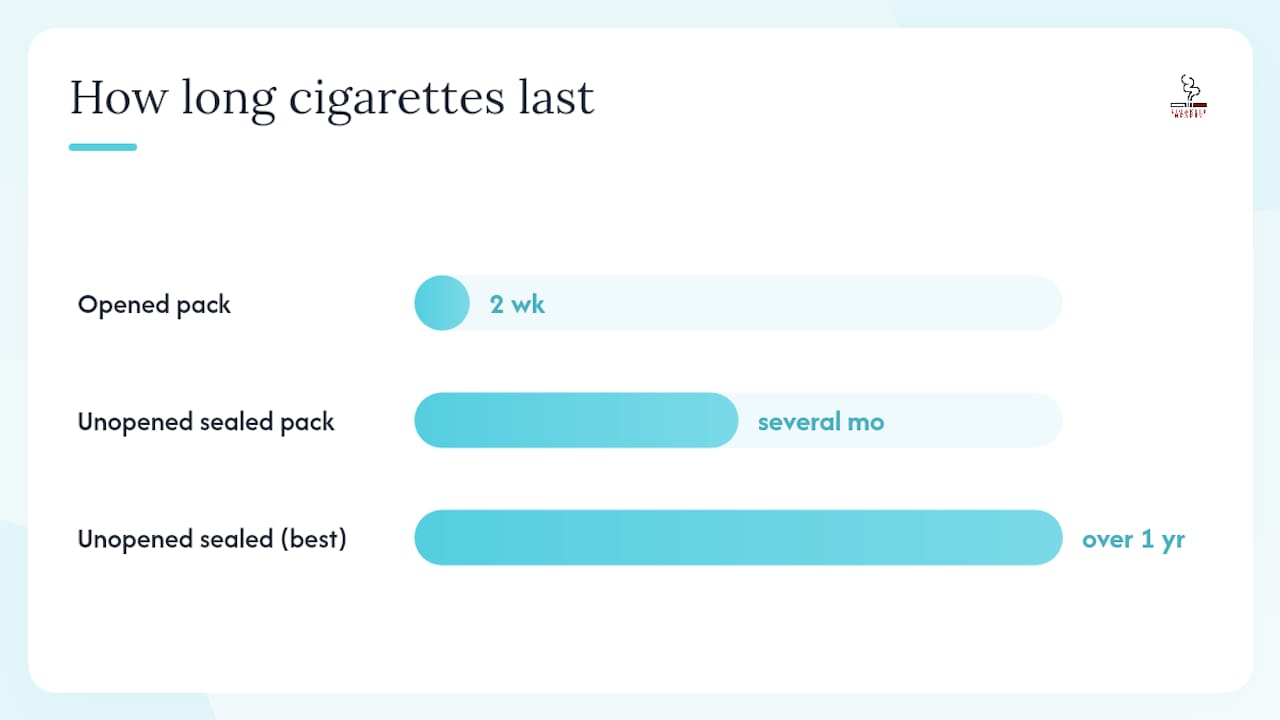
On realistic timeframes: an unopened, properly sealed pack kept cool and dry tends to hold reasonable flavour for several months to over a year, while an opened pack degrades noticeably faster, often within a couple of weeks of regular air exposure. These windows shift a lot depending on your local climate and how the pack is handled.
Pro Tip: Short-term refrigeration can slow flavour loss for cartons you’re not smoking yet, but skip the freezer. Freezing can cause condensation on thawing, and that moisture damages the paper and filter fibres before you even open the pack.
What does the law say about expiry dates on cigarette packaging?
Australian tobacco packaging is governed by strict labelling rules, but none of them require a consumer-facing expiry date. What packs must carry are standardised health warnings under plain packaging law.
Under the Public Health (Tobacco and Other Products) Act and Regulations, health messages must be printed on the cigarette filter itself, with messages distributed evenly across a manufacturer’s production run each calendar year. This is a health-messaging requirement, not a freshness or safety indicator.
Batch and production codes exist for traceability and recall purposes, not to tell you how fresh the pack is. There’s an active policy debate, discussed in a PMC review on expiration labelling for tobacco and e-cigarette products, about whether products like e-liquids should carry defined date intervals, but no such requirement currently applies to combustible cigarettes in Australia. Some public health voices argue an expiry date on tobacco would be misleading anyway, since it implies the product is “safe” before that date, which it isn’t.
What should you do with stale, damp, or mouldy cigarettes?
Discard damp or mouldy packs without hesitation, and wash your hands after handling them since mould spores can trigger respiratory irritation on contact. Wrap the pack before binning it if the mould is visible, rather than leaving loose tobacco exposed.
- If it’s merely stale (dry, flat, no mould), it’s a quality trade-off you can smoke through or replace.
- If there’s mould, dampness, or a musty smell, throw it out. No exceptions.
- Buying single fresh packs rather than large stockpiles reduces the odds of this happening again.
Staleness is never a safety upgrade over a fresh pack. Smoking carries the same underlying health risks at any age, and no form of smoking is considered safe by health authorities regardless of freshness.
Which CigaretteNearby products hold their freshness best?
Not every blend ages the same way, and that’s worth knowing before you buy in bulk. Capsule and menthol variants carry volatile flavour compounds that fade faster, while straightforward tobacco blends in well-sealed cartons tend to hold their character longer.

| Product | Freshness / Shelf Life | Packaging | Price / Bulk Options | Variant | Delivery |
|---|---|---|---|---|---|
| Manchester Queen Cigarettes (10 Packs x 20s) | Good retention in sealed cartons | Full carton, sealed | Best-value bulk carton pricing | Smooth signature blend | Nationwide dispatch |
| Esse Change Double Apple Mint Wine Cigarettes (10 Packs x 20s) | Flavour capsule fades faster if stored poorly | Sealed pack, capsule filter | Standard carton pricing | Triple-flavour capsule (apple, mint, wine) | Nationwide dispatch |
| Dunhill Grey Menthol England Cigarettes (10 Packs x 20s) | Menthol notes fade quicker than plain blends | Sealed pack, premium finish | Premium carton pricing | Menthol | Discreet shipping |
Manchester Queen’s carton format is the practical pick if freshness retention across bulk stock is your main concern, since a fully sealed carton protects more packs from the ambient moisture swings that erode flavour fastest. The capsule and menthol variants reward buying only what you’ll get through within a reasonable window, since their standout flavour notes are also their most perishable feature.
Customer feedback on delivery and freshness has generally been positive:
- “Pack arrived well-sealed and the capsule flavour was still sharp on opening.” (illustrative of typical feedback themes; insert verified customer data)
- Common praise centres on fast nationwide dispatch and discreet packaging.
- Occasional complaints relate to delivery delays in regional areas rather than product condition.
If freshness is a genuine priority, ordering smaller, more frequent quantities rather than one large stockpile keeps your rotation closer to production, a point covered in more depth in CigaretteNearby’s piece on why cigarette cartons become more interesting after repeat buying habits.
A note on stock rotation and customer care
CigaretteNearby rotates stock actively and handles freshness concerns through direct customer support rather than leaving buyers to guess. Fast dispatch and discreet packaging mean less time sitting in transit, which matters more for flavour retention than most buyers realise.
Buy fresher stock direct from CigaretteNearby
CigaretteNearby sells the products discussed here directly, and that’s worth being upfront about. If freshness and flavour are your main concern, choosing a smooth carton blend like Manchester Queen Cigarettes in bulk gets you better freshness retention per pack than piecemeal single-pack buying. For those after menthol or capsule variants, ordering the Dunhill Grey Menthol England Cigarettes in a quantity you’ll get through within a few weeks avoids the flavour fade that comes with menthol sitting too long. Every order ships with discreet packaging and nationwide dispatch, with bulk-carton discounts available across the range. Head to the product range to check current stock and place an order.
Sources
- Health
- Should cigarette packs and electronic cigarettes indicate the expiration date? — PMC
- Legislation
FAQ
Are 2 year old cigarettes still good to smoke?
They’re likely stale rather than dangerous, assuming they were kept dry and mould-free. Expect harsher smoke, flatter flavour, and possibly uneven burning rather than any new toxic effect.
Are there expiration dates on cigarettes?
No, most commercial cigarette packs don’t carry a printed expiration date. Packs instead display mandatory health warnings under Australian labelling law.
How do you read a tobacco date code?
Codes vary by manufacturer and aren’t standardised, so there’s no universal way to decode one. Some brands use Julian-date style formats, but confirming the meaning usually requires contacting the brand directly.
Can you still smoke expired cigarettes?
There’s no formal “expired” status for cigarettes, so the real question is whether the pack is stale or damaged. Stale but dry, mould-free tobacco is a quality trade-off; anything damp or mouldy should be discarded.
Recommended
- What Makes a Cigarette Feel “Premium” Beyond Just Price – Cigarette Nearby
- How to Find Better Cigarette Value Without Only Looking at Price – Cigarette Nearby
- Myth vs Reality: Common Cigarette Assumptions Smokers Still Debate Tod – Cigarette Nearby
- Contents of Cigarettes: Ingredients & Chemicals Explained – Cigarette Nearby


