





A standard 20-pack in Australia in 2026 runs roughly $40 to $65, depending on brand tier, with supervalue and value lines sitting near the bottom and premium imports at the top. Excise tax is the single biggest driver of that number: the per-stick rate sits at $1.52829 from 3 March 2026, rising to $1.55274 from 1 September 2026. On a 20-stick pack, that alone works out to roughly $30 to $31 in excise before GST is even added.
That is the simple version. The longer version, which matters if you smoke regularly or watch tobacco policy, involves twice-yearly indexation, a shrinking legal market, and a very large illicit trade that is reshaping the whole picture.
- Supervalue/value packs: roughly $39 to $41 for a 20-pack
- Mainstream brands: roughly $50 to $55 for a 20-pack
- Premium brands: roughly $58 to $65 for a 20-pack
Quick fact: Australia’s Bureau of Statistics estimates around 80% of tobacco and nicotine products consumed nationally in 2025 came from the illicit market, a direct response to how steep legal prices have become since 2016.
Key Takeaways
Legal cigarette prices in Australia in 2026 are set almost entirely by a twice-yearly excise formula, and lawful savings now come from bulk buying and timing, not from chasing the shrinking gap with illicit tobacco.
| Point | Details |
|---|---|
| 2026 price range | A legal 20-pack costs roughly $39 to $65 depending on segment, with excise making up most of that figure. |
| Excise rises twice yearly | Per-stick excise moves from $1.52829 to $1.55274 across the March and September 2026 indexation dates. |
| Illicit market is large | ABS estimates around 80% of tobacco consumed nationally in 2025 came from illicit sources, carrying real product and legal risk. |
| RYO’s edge has narrowed | Equivalisation changes reaching 0.6g per stick by September 2026 mean rolling tobacco no longer beats factory-made by the margin it once did. |
| Buy bulk from a verified seller | CigaretteNearby offers bulk cartons across value, mainstream and premium brands with Australia-wide delivery and discreet packaging. |
Table of Contents
- Cigarette prices Australia 2026: what sets the tax rate
- What does a 20-pack actually cost by brand tier?
- Why has the illicit tobacco market grown so much?
- Why do state licensing rules push retail prices up?
- How can you legally reduce cigarette costs in 2026?
- CigaretteNearby catalogue picks for value-conscious buyers
- What’s forecast for cigarette prices and excise through the rest of 2026?
- How does the government decide excise increases?
- Are smokers actually buying less because of 2026 prices?
- How do Australian cigarette prices compare internationally?
- A smoker’s story: switching to lawful online buying
- Why the price debate misses the point for most smokers
- Shop bulk pricing with CigaretteNearby
- Sources
- FAQ
Cigarette prices Australia 2026: what sets the tax rate
Australia doesn’t set a single flat tobacco tax and leave it there. The excise system is built to rise automatically, twice a year, and 2026 is a good year to see exactly how that machinery works.
- Per-stick and per-kilogram rates. The Australian Taxation Office lists the per-stick excise at $1.52829 from 3 March 2026, climbing to $1.55274 from 1 September 2026. Loose tobacco (RYO) is taxed per kilogram, and that rate rises in the same September update.
- AWOTE indexation, twice yearly. Excise is indexed to Average Weekly Ordinary Time Earnings each March and September, not to the consumer price index. Because wages have generally outpaced general inflation in recent years, this indexation method has pushed tobacco excise up faster than everyday cost-of-living increases.
- RYO equivalisation tightening. Loose tobacco is taxed as though a fixed weight equals one “stick” for excise purposes. That equivalence weight was reduced on a schedule that reaches 0.6 grams per stick-equivalent by 1 September 2026, under the Excise Tariff Amendment (Tobacco) Act 2024. A lower equivalence weight means more excise is charged per kilogram of rolling tobacco, narrowing the price gap between RYO and factory-made cigarettes that used to make roll-your-own the budget option by default.
By the numbers: a 20-stick pack sold after 1 September 2026 carries roughly $31.05 in excise alone, before GST is calculated on the tax-inclusive price.
The Parliamentary Library’s 2026 tobacco control research notes these successive rises have made Australian cigarette prices among the highest in the world. Whether that has reduced smoking as intended, or simply shifted purchases elsewhere, is the debate running through the rest of this article.
What does a 20-pack actually cost by brand tier?
From 1 July 2025, Australia standardised cigarette packs to 20 sticks, closing off the larger pack sizes retailers previously used to spread costs and confuse per-stick comparisons. That single change makes 2026 price data easier to compare than at any point in the last decade, because every pack on the shelf is now measured against the same 20-stick baseline.
Segment averages reported by Tobacco in Australia at September 2025 give a clear ladder:
- Supervalue: average around $39.69 per 20-pack
- Value: average around $40.66 per 20-pack
- Mainstream: average around $54.99 per 20-pack
- Premium: average around $60.72 per 20-pack
A named example from that same data set: JPS 20s were priced at approximately $42.99, sitting near the top of the value tier, and illustrating how thin the gap has become between “cheap” and “mainstream” brands once excise is baked into every pack regardless of tier.
Do the per-stick maths and the picture sharpens further. A supervalue pack at $39.69 works out to roughly $1.98 per stick. A premium pack at $60.72 works out to around $3.04 per stick. That’s a real difference over a week of smoking, but it’s smaller than most smokers assume, because excise applies at the same per-stick rate regardless of which tier you buy. The brand premium you’re paying for at the top end is genuinely just brand and packaging. Almost none of it is extra tax.

Pack-size standardisation had a second, quieter effect: it removed the larger 25s and 30s packs that used to lower the effective per-stick price for bulk buyers at retail. With everything now sold in 20s, the only way left to reduce your per-stick cost is buying multiple packs at once, or buying rolling tobacco, both of which behave differently under the excise equivalisation rules described above.
Retailers in different states report slightly different averages depending on local licensing costs and competition, but the segment bands above hold reasonably steady nationally. If you’re comparing a receipt against these figures, it’s worth checking which segment your usual brand sits in rather than assuming all “20-packs” are priced the same.
Why has the illicit tobacco market grown so much?
Roughly 80% of tobacco and nicotine product quantity consumed in Australia in 2025 came from illicit sources, according to ABS estimates combining wastewater testing with administrative data. That’s not a fringe statistic. It means the legal, taxed market that sets the prices discussed above now covers a minority of actual cigarette consumption nationally.
The drivers are straightforward once you line them up:
- Price differential. Legal packs at $40 to $65 versus illicit packs frequently sold for $15 to $20 create an enormous financial incentive to switch.
- Organised supply chains. Illicit tobacco in Australia isn’t casual backyard operations; it moves through networks capable of importing container-scale volumes.
- Retail visibility. Illicit product is now sold openly in some suburban shopfronts, not just through informal channels, which has normalised the purchase for many smokers.
- Enforcement lag. Border and domestic enforcement resourcing hasn’t kept pace with the scale of the shift.
The gap between legal and illicit prices has become wide enough that, as one senior former tax office official put it in coverage of the crisis, “there’s a very significant profit to be made” in trafficking illegal tobacco into Australia, a dynamic ABC News reporting on the illicit trade ties directly to organised crime involvement and falling tax revenue.
Quick fact: the same ABS analysis and subsequent reporting links the illicit surge to billions in lost federal tobacco tax revenue, prompting a coordinated enforcement response involving the Illicit Tobacco Commissioner and multiple agencies.
Buying illicit tobacco carries risks beyond the legal exposure of possessing untaxed goods. Product tested from seized illicit shipments has shown inconsistent contents, unknown storage conditions, and no quality control at any stage. There’s no packaging integrity guarantee, no verified sourcing, and no consumer recourse if something goes wrong. Interestingly, AIHW survey data shows daily smoking prevalence kept falling even as illicit volumes rose, which points to existing smokers substituting supply channels rather than a wave of new smokers driving the illicit market.
Why do state licensing rules push retail prices up?
Every state now runs a tobacco retailer licensing scheme, and the fees and compliance burden attached to those schemes are a real, if underappreciated, part of what you pay in a bricks-and-mortar shop. Victoria’s mandatory licensing regime takes full effect from February 2026, joining similar frameworks already running in New South Wales and Queensland.
These schemes exist to curb illicit sales at the retail level, but compliance isn’t free for the shopkeeper:
- Licensing fees that must be renewed annually, varying by state and store type
- Security upgrades, including surveillance systems and safes, following a wave of tobacco-related shop robberies
- Compliance staff time for age verification, plain packaging checks and record keeping
- Insurance premiums that have risen for retailers stocking high-value tobacco products
None of that shows up as a separate line on your receipt, but it’s baked into the shelf price. Physical retailers also carry rent, staffing across trading hours, and stock security costs that an online operation running from a centralised warehouse simply doesn’t carry at the same scale. That structural difference is a genuine part of why compliant online sellers, including CigaretteNearby, can often list lower prices than the servo or corner store down the road, without cutting any legal corner.
Pro Tip: Before buying from any online tobacco retailer, check they display an ABN, issue a proper tax invoice, and can explain their excise compliance if asked. A legitimate seller has nothing to hide about how their pricing works.
How can you legally reduce cigarette costs in 2026?
Cutting your legal tobacco spend in Australia comes down to a handful of concrete moves, none of which involve touching the illicit market.
- Compare RYO against factory-made per stick, not per pack. A 30g pouch of rolling tobacco makes roughly 40 to 50 cigarettes depending on how tightly you roll. Even with the RYO equivalisation weight tightening toward 0.6g per stick-equivalent by September 2026, rolling your own still tends to work out cheaper per stick than most mainstream factory packs, though the margin has narrowed noticeably since 2016.
- Buy in genuine bulk, and check the actual unit price. A carton of 10 packs should cost less per stick than buying single packs one at a time. Divide the total price by the total stick count to confirm the discount is real rather than a marketing figure. CigaretteNearby’s guide to reducing cigarette costs walks through this unit-price maths in more detail.
- Time larger purchases around the March and September indexation dates. Stocking up in the week before either date, so long as you store tobacco properly, means you avoid paying the freshly indexed rate on that batch. It’s a modest saving, but it’s real and entirely lawful.
- Verify any online seller before you buy. Genuine Australian tobacco retailers list an ABN, clear delivery terms, and don’t advertise prices so far below the segment averages listed earlier that they’d be commercially impossible without an untaxed supply chain.
Pro Tip: If an online price looks too good against the $39 to $65 range for legal 20-packs described above, treat that as a warning sign rather than a bargain. Genuine cheap cigarette online retailers still pay the same excise you do, so their discounts come from volume and lower overheads, not from skipping tax.
For readers weighing rolling tobacco more broadly, CigaretteNearby’s 2026 guide to cheap tobacco in Australia covers legal nicotine alternatives and current pricing trends across product types.
CigaretteNearby catalogue picks for value-conscious buyers
CigaretteNearby stocks bulk packs across value, mainstream and premium tiers, which makes it straightforward to compare per-stick cost across brands before you commit to a carton.
- Davidoff Red Cigarettes, 10 packets x 20s: a full-flavour European blend suited to smokers who want a recognised premium name without paying single-pack pricing across ten packs, with fast delivery Australia-wide.
- Manchester Reserve Cigarettes, 10 packets x 20s: a rich, full-bodied premium blend, best for smokers prioritising flavour intensity over brand name recognition, sold in the same bulk 10-pack format.
- Marlboro Red Cigarettes, 10 packets x 20s: the classic full-flavour blend, best for smokers who want a mainstream brand at a lower per-stick cost than buying single packs at retail, with fast Australia-wide delivery and discreet packaging.
Each listing shows the bulk price broken down so you can check the per-stick equivalent yourself before ordering, which is the same unit-price discipline worth applying to any tobacco purchase, online or in-store.
What’s forecast for cigarette prices and excise through the rest of 2026?
The confirmed rate path for 2026 is already public: excise steps up on 3 March to $1.52829 per stick and again on 1 September to $1.55274, both figures set by the ATO’s standing indexation formula rather than a fresh budget announcement. Barring a specific policy intervention, retail prices generally track these indexation dates within a few weeks, as retailers and distributors adjust shelf pricing to preserve margins.
The genuinely open question for 2026 isn’t the excise schedule, it’s whether the federal government responds to the illicit market growth with a policy shift. The Parliamentary Library’s research canvasses options ranging from further enforcement funding to, more controversially, an excise pause or reduction aimed at narrowing the price gap that fuels illicit substitution. No such change had been legislated as this indexation schedule locked in, but it remains the subject of live budget debate given the scale of lost tax revenue.
For smokers and policy watchers alike, the practical takeaway is that price rises in 2026 are baked in by formula, not discretion, unless a specific legislative change intervenes. Watching for federal budget statements around March and May remains the most reliable way to catch any policy shift before it reaches shelf prices.
How does the government decide excise increases?
Australia doesn’t set tobacco excise through annual budget debate the way some taxes work. Instead, Parliament long ago legislated an automatic formula: index the rate to AWOTE every March and September, indefinitely, until a future Parliament changes the law. That’s why the 2026 rates were knowable in advance rather than announced fresh each year.
The rationale, as laid out in Parliamentary Library research on tobacco control policy, rests on a public health argument: higher prices reduce consumption, particularly among younger and price-sensitive smokers, and tying the rate to wage growth rather than general inflation keeps tobacco getting relatively more expensive even when the cost of living elsewhere slows down.
The same research is candid that this approach has a cost. That tension, price signal versus enforcement capacity, is the live policy fight behind every excise date on the calendar.
Are smokers actually buying less because of 2026 prices?
Not in the way the headline price suggests. AIHW National Drug Strategy Household Survey data shows daily smoking prevalence continuing its long decline, sitting around 5.6% in the most recent figures. Read alone, that looks like proof the excise strategy is working exactly as designed.
Read alongside the ABS illicit consumption estimate, a more complicated pattern emerges. Fewer Australians report smoking daily, but the volume of tobacco actually being consumed hasn’t fallen anywhere near as sharply, because a large share of it has simply moved to the untaxed, unmeasured illicit market. Existing smokers are substituting supply channels rather than quitting in the numbers the price rises alone would predict.
For behaviour specifically, that means three things are likely happening at once in 2026: some smokers are genuinely cutting back or quitting in response to price, some are switching from factory-made to RYO or vice versa depending on which stays cheaper, and a substantial group has moved some or all of their purchasing to illicit sellers without changing how much they actually smoke. Any single statistic, cited alone, risks telling only one-third of that story.
How do Australian cigarette prices compare internationally?
Australia’s tobacco excise regime produces some of the highest legal cigarette prices in the developed world, a position the Parliamentary Library’s 2026 research confirms explicitly rather than as a rough estimate, illustrated by an international price & condition comparison showing the scale of Australian tobacco costs.
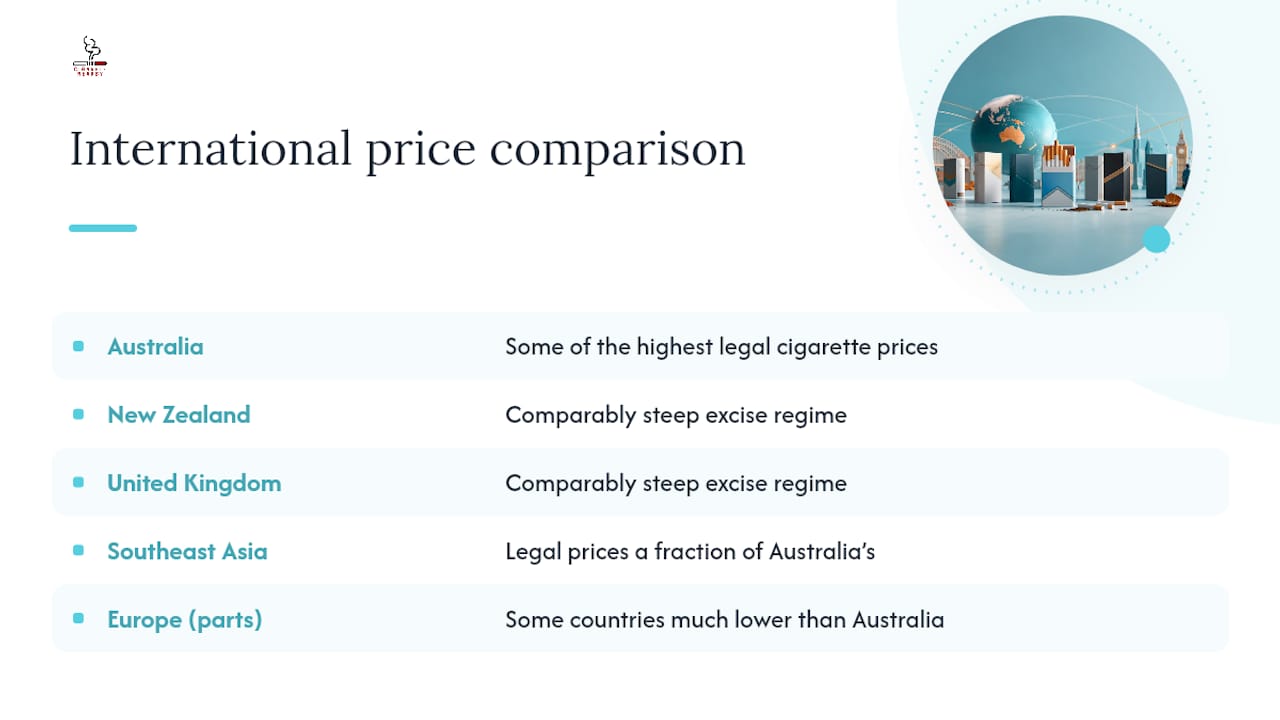
Countries like New Zealand and the United Kingdom run comparably steep excise regimes and have seen similar debates about illicit substitution, though their indexation mechanisms and rates differ from Australia’s AWOTE-linked formula. By contrast, many countries in Southeast Asia and parts of Europe maintain legal cigarette prices at a fraction of Australia’s, which is precisely why cross-border and postal illicit supply chains find Australia such a profitable destination.
The comparison matters less as a league table and more for what it explains: Australia’s high legal price isn’t an accident of retail markup, it’s a deliberate, decades-long policy choice to make legal tobacco progressively more expensive than almost anywhere else. Whether that policy continues to deliver public health gains without simply handing volume to organised crime is the exact debate playing out in enforcement and budget circles through 2026.
A smoker’s story: switching to lawful online buying
A Brisbane smoker who’d been buying two packs a week at a local Queensland service station described the shift in household budgeting once cigarette prices crossed the $55 mark for their usual mainstream brand. Switching to bulk cartons through a compliant online retailer, ordering ten packs at once rather than single packs, brought the effective per-stick cost down noticeably, even after accounting for the same excise and GST every retailer has to charge.
The other change wasn’t financial. Delivery arrived in plain, discreet packaging within the promised window, with no need to explain a bulk tobacco purchase to anyone at the counter. For readers weighing the same switch, CigaretteNearby’s guide on buying cigarettes legally in Australia covers what to check before placing a first order.
Why the price debate misses the point for most smokers
Most coverage of Australian cigarette prices treats the excise increase itself as the story. It isn’t, not really.
That reframes the practical question for smokers. It’s not “how do I avoid the tax,” because that path runs straight into product safety risk and legal exposure with no quality control behind it. It’s “how do I minimise legal spend without touching that risk,” and the honest answer sits in unit-price discipline: buying bulk from a verified seller, timing purchases around indexation dates, and understanding that RYO’s cost advantage over factory-made has genuinely narrowed since the equivalisation changes began. Anyone still assuming rolling tobacco is automatically the cheap option hasn’t looked at the 2026 numbers closely enough.
The other overlooked point is that falling smoking prevalence and rising illicit consumption aren’t contradictory statistics, they’re the same policy producing two different effects on two different groups. Policy watchers who cite one figure without the other are telling half the story, deliberately or not.
— Cigarette Online
Shop bulk pricing with CigaretteNearby
CigaretteNearby exists for exactly the gap this article has walked through: legal excise applies to every pack sold, but bulk buying and lower retail overheads mean the per-stick price doesn’t have to sit at the top of the mainstream and premium bands discussed above. Unlike a servo or tobacconist carrying state licensing fees and security costs on every sale, CigaretteNearby runs on centralised fulfilment, which shows up as lower shelf prices on the same taxed, legal stock.
The catalogue spans value, mainstream and premium tiers, from bulk Marlboro Red cartons to Davidoff Red ten-packs, all shipped Australia-wide in discreet packaging with 24/7 customer support if a delivery question comes up. If you’re weighing up a bulk order for the March or September indexation window, browse the current catalogue and check the per-stick pricing against the segment averages covered earlier before you order.
Sources
- Household consumption of illicit tobacco and nicotine products | Australian Bureau of Statistics
- Excise duty rates for tobacco | Australian Taxation Office
- 13.3 How much do tobacco products cost in Australia? - Tobacco in Australia
- The future of tobacco control in Australia | Parliamentary Library (2026)
FAQ
What is the price of a pack of 20 cigarettes in Australia?
A legal 20-pack in 2026 typically costs between $39 and $65, depending on whether it’s a supervalue, value, mainstream or premium brand.
How much does a 20-pack of mainstream brand cigarettes cost at major supermarkets?
Mainstream 20-packs average around $54.99 at major retailers, though prices vary slightly by state due to local licensing and operating costs.
How much does a packet of 40 cigarettes cost in Australia?
Since pack-size standardisation took effect in July 2025, 40-packs are no longer sold; buying two standardised 20-packs at supervalue pricing costs roughly double the typical $39 to $41 range per pack.
What is the cheapest cigarette brand in Australia?
Supervalue and value-tier brands average $39.69 to $40.66 per 20-pack, the lowest legal pricing tier, though bulk buying through a verified online retailer like CigaretteNearby can lower the effective per-stick cost further.
Is it legal to buy cigarettes online in Australia?
Yes, buying from a compliant Australian retailer that charges the correct excise and GST and verifies age is legal; the risk lies specifically with unlicensed sellers offering suspiciously low prices.
Recommended
- How to Reduce Cost of Cigarettes in Australia: 2026 Guide – Cigarette Nearby
- Cheap Tobacco Australia: Finding Value in 2026 – Cigarette Nearby
- Cigarette in Australia: Complete Guide for Adult Smokers 2026 – Cigarette Nearby
- Cigarette Offers Across Australia: What Smokers Notice – Cigarette Nearby
Online Cigarette Nearby provides articles for general information only and may not offer professional advice. Some content is intended for adults aged 18+ only. Help quitting smoking, contact your local Quitline.


