





Yes, you can legally buy discounted cigarettes and bulk rolling tobacco online in Australia, provided the retailer holds proper state licensing, verifies your age, and prices its stock with excise duty already built in. That last point matters: the Australian Taxation Office currently sets excise at $1.55274 per stick and $2,587.90 per kilogram for loose tobacco, so no online discount ever bypasses that baseline. It’s added at manufacture or import, then folded into the shelf price you see.
Before you place an order, two checks separate a compliant seller from a risky one:
- The retailer verifies you’re over 18 through a proper ID check, not just a tick box.
- The site displays a valid state retail licence and quotes prices that already include excise.
CigaretteNearby operates as a licensed online tobacco retailer built around exactly these checks, giving Australian smokers a straightforward way to buy cartons and bulk RYO tobacco without guessing whether a seller is doing the right thing.
Key Takeaways
Legal, discounted tobacco in Australia comes from licensed online retailers who verify your age, display their state licence, and price with excise already included.
| Point | Details |
|---|---|
| Excise sets the floor | $1.55274 per stick and $2,587.90 per kilogram forms the base cost behind every legal price. |
| Licensing is now standard | NSW, Victoria, and Queensland all require displayed retail licences for online tobacco sellers from mid-2025. |
| Packaging tells the story | Plain packs with graphic health warnings on every product photo signal a compliant retailer. |
| Unregulated stock carries real risk | Skipping the licensed system means no verified content, no consumer protection, and possible penalties. |
| CigaretteNearby fits the compliant path | It combines excise-inclusive bulk pricing, verified age checks, and discreet Australia-wide delivery. |
Table of Contents
- What legal and state rules you must check before ordering illicit tobacco Australia style deals
- How excise duty and indexation shape price, and when bulk buying actually pays off
- Checklist: how to verify an online tobacco retailer is compliant and safe to buy from
- Cigarette Nearby’s range: which product suits which smoker
- How big is Australia’s legal tobacco market compared to the black market?
- How do authorities detect illegal tobacco trading in Australia?
- What happens if you deal in illicit tobacco in Australia?
- How do you report suspected illicit tobacco activity?
- What are the health risks of unregulated tobacco products?
- What does the illicit tobacco trade cost Australia economically?
- A real order, start to finish
- Why CigaretteNearby is worth ordering from
- Sources
- FAQ
What legal and state rules you must check before ordering illicit tobacco Australia style deals
Every state now treats online tobacco sales the same way it treats a bricks-and-mortar shop: strict age control, standardised packaging, and a licence trail you can actually check. Before you hand over your card details anywhere, run through these four checks.
- Age verification at checkout. Selling or supplying tobacco to anyone under 18 is illegal in every Australian jurisdiction, and the Department of Health requires online retailers to confirm age before dispatch, not just at delivery.
- Plain packaging and health warnings. Every product photo on a legitimate site shows the standardised plain pack with graphic health warnings. Stylised branding on a product page is a red flag, not a feature.
- State retail licensing. NSW brought in a licensing scheme for tobacco retailers and wholesalers, including online sellers, from 1 July 2025, and requires a copy of that licence displayed at the point of sale. Victoria followed with its own scheme from the same date, with enforcement ramping up through 2026, and Queensland has matched provisions under its own Tobacco and Other Smoking Products Act.
- Border and import restrictions. If a “deal” involves tobacco shipped from overseas, be careful. The Australian Border Force lists tobacco among controlled import goods, and unexpected import parcels can be seized or attract extra duty.
One detail worth remembering: South Australia runs tighter controls that limit some forms of internet tobacco sale outright, so always confirm a retailer explicitly ships to your state before ordering.
None of this is red tape for its own sake. It’s the difference between a shop you can trust with your card details and one that disappears with your order.
How excise duty and indexation shape price, and when bulk buying actually pays off
Excise is the single biggest input into what you pay for tobacco in Australia, and it moves twice a year. The ATO indexes both the per-stick and per-kilogram rates every March and September in line with average wage growth, which is why the same carton can cost slightly more from one half of the year to the next.
At the current excise rate per stick, a standard carton of 200 cigarettes carries a significant amount of excise alone before any retail margin, freight, or GST is added. Loose tobacco works differently: it’s taxed by weight at $2,587.90 per kilogram, using an equivalisation weight that treats loose tobacco as roughly comparable to manufactured sticks for duty purposes. That’s why a 1kg bag of rolling tobacco often works out cheaper per gram than the same weight bought in small pouches.
Here’s a simple way to compare offers:
- A single 20-pack priced without context tells you almost nothing about value.
- Divide the total carton or bulk-bag price by the number of sticks (or grams) to get a genuine price-per-unit figure.
- Compare that figure against the excise-inclusive baseline. If a “70% off” deal still sits below the excise cost alone, something is wrong with the listing.
Industry analysis of the tobacco excise system confirms that indexation is the main driver of Australia’s high retail prices, and that genuine bulk discounts come from volume buying on top of that fixed tax, not instead of it. That’s the only kind of discount worth chasing.
Checklist: how to verify an online tobacco retailer is compliant and safe to buy from
Run through this before you check out on any site, not just the first time you buy.
- Find the licence number and ABN. A compliant retailer displays its state retail licence and Australian Business Number somewhere on the site, usually in the footer or an “About” or “Compliance” page. If you can’t find one, treat that as a warning sign.
- Check the product photos. Genuine listings show the plain, standardised pack with mandatory warnings, matching what WIPO’s analysis of Australia’s plain packaging laws describes as the legal baseline for all tobacco packaging sold in the country.
- Read the age verification and returns policy. Look for a clear statement on how age is checked, whether ID is required on delivery, and what happens if an order is refused or returned.
- Confirm delivery terms. A legitimate seller states which states it ships to, whether packaging is discreet, and roughly how long delivery takes.
- Walk away if information is missing. If licence details, packaging images, or age checks aren’t visible, choose a different, clearly licensed retailer instead.
Pro Tip: Bookmark the licence or compliance page of any retailer you buy from regularly. State licensing details occasionally change as schemes like Victoria’s and Queensland’s move from registration into active enforcement, and a retailer that keeps its compliance page current is one that takes the rules seriously.
CigaretteNearby’s guide to wholesale tobacco licensing in Australia walks through exactly what a licence display should look like if you want a worked example before you shop elsewhere.
Cigarette Nearby’s range: which product suits which smoker
Once you know what to check, the next question is simple: what should you actually buy? CigaretteNearby’s catalogue is built around bulk value and everyday carton pricing, all priced with excise already included.
For heavy RYO smokers:
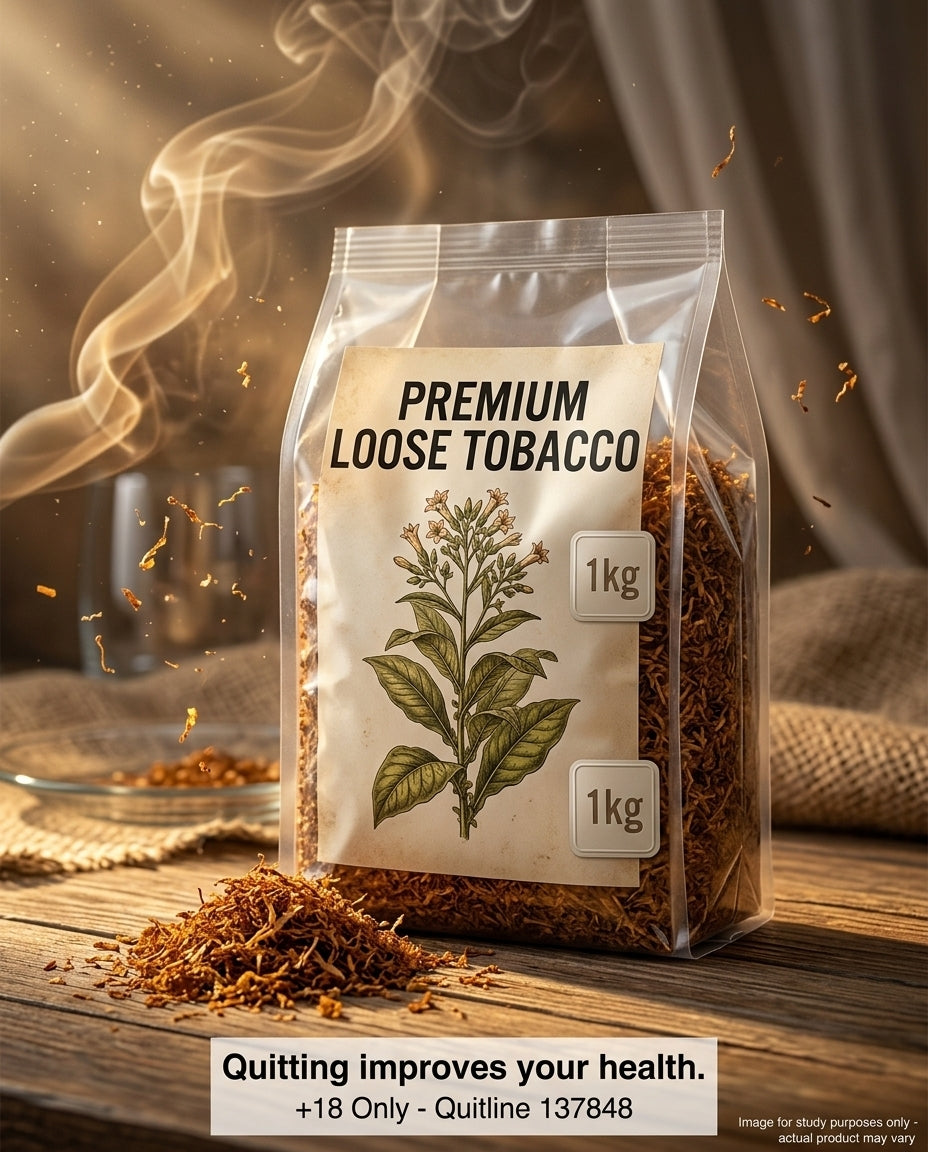
- Premium Loose Tobacco 1kg (Resealable Bag) delivers a deep, natural tobacco character at bulk pricing, and the resealable bag keeps it fresh through the weeks it takes to work through a full kilo.
- Premium Loose Tobacco 500g (Resealable Bag) suits smokers who want the same rich, natural blend without committing to a full kilogram upfront.
- Golden Virginia Japanese 500g Premium Loose Tobacco offers a fine-cut, smooth blend for those who prefer an established brand at bulk pricing with nationwide dispatch.
- Golden Virginia Japanese 100g Premium Loose Tobacco is the entry point if you’re testing the blend before committing to bulk, with the same smooth fine-cut profile and fast delivery.
For carton buyers:
- Dunhill Blue England Cigarettes (10 Packs x 20s) suits smokers after a smooth, mild blend from a recognised name, with discreet delivery built into the order.
- TS Gold Cigarettes (10 Packs x 20s) suits budget-focused buyers after a light, smooth tobacco profile in affordable carton form.
- Manchester Classic Blue Plain Package Cigarettes 20s (10 Packs) gives everyday smokers a smooth, no-frills carton at an affordable delivered price.
- Manchester Superslims Chocolate Cigarettes (10 Packs x 20s) suits smokers after a slim style with a light cocoa aroma, at carton pricing with fast Australia-wide delivery.
Working the ATO’s per-stick excise rate against a standard 200-stick carton puts the tax component alone above $300, so any carton listing sitting close to or below that figure warrants a second look at the seller’s licensing before you buy. Browse the full cigarette range or tobacco range to compare current stock and pricing.
How big is Australia’s legal tobacco market compared to the black market?
Australia’s legal tobacco market has shrunk for two decades as smoking rates decline and excise pushes retail prices higher, while a parallel unregulated trade has grown alongside it. That unregulated segment, often called illicit tobacco or the illicit tobacco trade, sits entirely outside the licensing, packaging, and duty rules this guide has covered. It’s a genuinely different market to the one you’re shopping in when you buy from a licensed retailer like CigaretteNearby.
The practical impact for everyday smokers is price distortion. When unregulated tobacco circulates without excise paid, it can undercut licensed sellers on price, which puts pressure on the legal retail sector and confuses buyers trying to work out what a fair price actually looks like. That’s part of why this guide keeps circling back to excise-inclusive pricing: it’s the one number that tells you whether a deal reflects genuine bulk savings or something else entirely.
For everyday buyers, the takeaway is straightforward. A retailer operating within the legal system will always price around the ATO’s excise figures, display its state licence, and verify your age properly. A price that ignores all three of those facts isn’t really a discount. It’s a sign the product may have skipped the tax and compliance system altogether, which carries its own separate risks covered in the next few sections.
How do authorities detect illegal tobacco trading in Australia?
State and federal agencies use a mix of intelligence, physical inspection, and supply chain tracking to identify tobacco moving outside the licensed system. The Australian Border Force screens international mail and cargo for undeclared tobacco, since it sits on the controlled and prohibited goods list, while state health departments now run licensing inspectors who can check any retailer’s paperwork on the spot.
South Australia has taken this further with dedicated compliance funding aimed specifically at unlicensed tobacco and vape sales, reflecting a broader national shift toward active enforcement rather than passive rule-setting. Retail licence registers, introduced in NSW, Victoria, and Queensland from mid-2025, give inspectors a simple way to cross-check whether a shop or website is entitled to sell at all. A retailer with no licence number, no ABN, and no verifiable business address is exactly the profile these checks are designed to catch.
Detection also relies on tip-offs from the public and from compliant retailers who notice unusually cheap stock circulating in their area. This is part of why the licensing display requirements matter so much for you as a buyer. They aren’t just a compliance box for the seller. They’re the same information trail investigators use, which means a retailer happy to show its licence upfront is telling you something real about how it operates.
What happens if you deal in illicit tobacco in Australia?
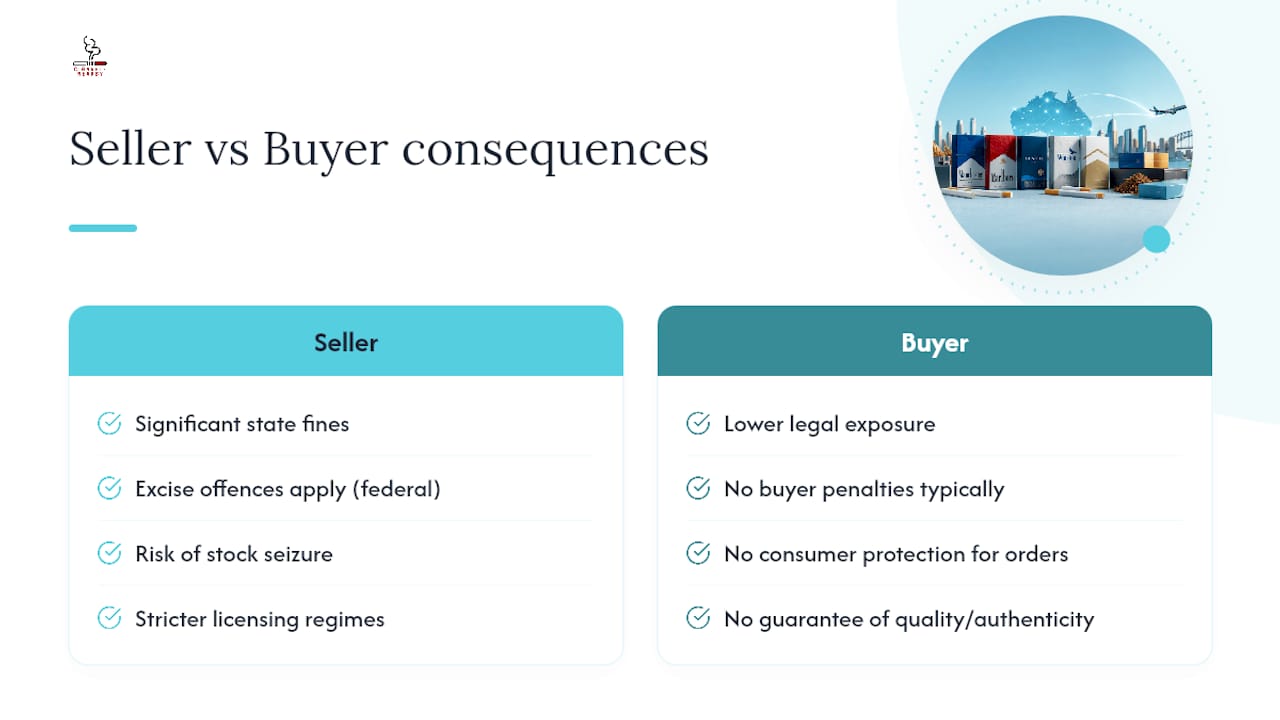
Penalties for trading in unlicensed or untaxed tobacco are substantial and getting tougher as states finish rolling out their licensing regimes. Selling tobacco without a required state licence, or supplying it to a minor, can attract significant fines under state health legislation, with the exact figures varying by jurisdiction and by whether the offence involves a business or an individual.
Federal excise law adds another layer. Manufacturing, possessing, or selling tobacco where excise duty hasn’t been paid is a serious offence, since duty is meant to be paid at manufacture or when goods enter home consumption under ATO administration. Businesses caught operating without the required licence, or found supplying tobacco that has bypassed the excise system, risk having stock seized on top of any financial penalty.
For everyday smokers, the legal exposure is lower but not zero. Buying from an unlicensed seller doesn’t typically expose the buyer to the same penalties as the seller, but it does mean you have no consumer protection if the product is faulty, the order never arrives, or your payment details are misused. There’s also no guarantee the product itself has been through any quality or authenticity check.
This is the practical argument for sticking with a retailer that displays its licence, quotes excise-inclusive pricing, and runs proper age verification: it protects your order, not just the tax base.
How do you report suspected illicit tobacco activity?
If you come across a seller who won’t show a licence number, sells suspiciously cheap stock with no health warnings on the packs, or seems to be shipping tobacco into Australia without going through any import declaration, you can report it. Most states run a dedicated tobacco compliance line through their health department, the same body that manages licensing under schemes like those in NSW and Victoria.
Reports can generally be made anonymously, and you don’t need to be certain the activity is illegal. State health departments and the Australian Border Force would rather investigate a report that turns out to be nothing than miss one that’s real. If the concern involves goods arriving from overseas without declaration, the Border Force also accepts tip-offs through its own reporting channels alongside its published guidance on prohibited imports.
For buyers, the simplest practical safeguard is prevention rather than reporting after the fact. Sticking with a retailer that already displays its licence, verifies your age, and prices with excise included means you’re less likely to encounter a problem worth reporting in the first place. It also means if something does go wrong with your order, there’s an actual business behind it, with a licence number and an ABN, rather than a storefront that could vanish overnight.
What are the health risks of unregulated tobacco products?
Tobacco sold outside the licensed retail system skips the quality and packaging standards that apply to every product on a compliant retailer’s shelves. That includes the standardised plain packaging and mandatory graphic health warnings that Australia’s High Court upheld as a legal requirement for all tobacco products sold in the country, a decision WIPO’s analysis of the case covers in detail.
Beyond the packaging issue, there’s a genuine content risk. Product that hasn’t been through Australia’s regulated supply chain has no verified chain of custody, which means there’s no way to confirm what’s actually in it or how it’s been stored. Compliant retailers work within a system where product sourcing, storage, and labelling are all subject to inspection. Unregulated stock has none of that oversight.
There’s also a practical safety gap for the buyer. If a licensed product turns out to be faulty or misrepresented, you have consumer protection avenues and a business you can actually contact. Buying from an unverified source removes that safety net entirely, on top of whatever is in the product itself. For smokers who already accept the known health risks of tobacco, adding an unknown content risk on top is a genuinely avoidable extra.
What does the illicit tobacco trade cost Australia economically?
Unregulated tobacco sales bypass the excise system entirely, which means every unit sold that way represents lost revenue that would otherwise fund public services. Excise on tobacco is one of the larger indirect tax lines in the federal budget, and its size is precisely why avoidance is attractive to unlicensed operators in the first place.
There’s a flow-on effect for legitimate retailers too. A shop that pays its licence fees, verifies every customer’s age, and prices with full excise included is competing against sellers who carry none of those costs. That’s a genuine competitive disadvantage for compliant businesses, and it’s part of the reason states have moved from optional registration to active licensing enforcement over the course of 2025 and 2026.
The social side is less about dollars and more about consistency. Public health measures like plain packaging and advertising bans only work as intended if the products people actually buy go through that same regulated pathway. Every purchase made outside the licensed system chips away at that consistency, which is one reason compliance checks matter as much for buyers as for the businesses selling to them. Choosing a retailer that operates inside the system isn’t just a personal safeguard. It’s part of what keeps the broader framework functioning the way it’s meant to.
A real order, start to finish
A customer from outside Melbourne recently ordered a 1kg bag of loose tobacco alongside two cigarette cartons, expecting a week-long wait given how far bulk orders often need to travel. It arrived in under four days, packed discreetly with no branding visible on the outside of the parcel. The saving compared to buying the same volume in small retail packs came in well above what a single-pack price would suggest, purely from the bulk-bag pricing structure.
A quick question about delivery timing to a support line was answered within the hour, part of the 24/7 support that backs every order. That combination, fast dispatch, discreet packaging, and someone actually available to answer a question, is what tends to turn a first-time buyer into a repeat one.
Why CigaretteNearby is worth ordering from
CigaretteNearby exists for exactly the situation this guide has walked through: an adult smoker in Australia who wants a genuine bulk discount without gambling on a seller’s legitimacy. Every product listing carries excise-inclusive pricing, plain packaging, and the mandatory health warnings the law requires, so what you see at checkout is what you actually pay, no surprise add-ons once duty gets factored in.
Whether you’re after a 1kg bag of loose tobacco to cut your per-gram cost or a full carton from the cigarette range, the ordering process is the same: age verification at checkout, discreet packaging on dispatch, and support available around the clock if a question comes up mid-order. If you’re weighing tobacco against other options entirely, resources like Vape Alternatives to Quit cover that separate decision.
If bulk RYO is your main interest, start with the Premium Loose Tobacco 1kg bag and compare the per-gram cost against your current supplier. If cartons are more your habit, the Marlboro Red USA Cigarettes carton is a solid place to check current pricing against what you’re paying now.
Sources
- Excise duty rates for tobacco — Australian Taxation Office
- Laws in Australia — Australian Government Department of Health
- Tobacco licensing — NSW Health
- Tobacco retailers — Victorian Department of Health
- Tobacco — Australian Border Force
FAQ
Is it legal to buy discounted cigarettes online in Australia?
Yes, as long as the retailer holds a valid state licence, verifies your age, and prices its stock with excise duty included, buying discounted cigarettes or bulk RYO tobacco online is entirely legal.
How much of a cigarette’s price is tax?
At the current excise rate per stick, a standard carton of 200 cigarettes carries a significant amount of excise alone before any retail margin, freight, or GST is added.
How can I tell if an online tobacco retailer is licensed?
Check the site’s footer or compliance page for a displayed retail licence number and ABN, and confirm the product photos show standardised plain packaging with health warnings.
Does CigaretteNearby ship to every Australian state?
CigaretteNearby dispatches nationwide, though buyers in states with tighter online sale restrictions, such as South Australia, should confirm delivery eligibility before ordering.
What should I do if I suspect a seller is avoiding tobacco excise?
Report the seller to your state health department’s tobacco compliance line, or to the Australian Border Force if the goods appear to be arriving from overseas undeclared.
Recommended
- Cheap Tobacco Australia: Finding Value in 2026 – Cigarette Nearby
- Cigarette Nearby Offer Cheap Tobacco and Top Smokes Fast Free Shipping
- How to Find Cheap Rolling Tobacco Australia Without Comparing Forever – Cigarette Nearby
- Cities Where Cheap Rolling Tobacco Searches Are Growing Across Austral – Cigarette Nearby


