
















A lot of people start the search for wholesale tobacco Australia in the same place, a local tobacconist in Melbourne, Sydney, Perth, or a regional town, and they quickly realise the shelf price isn't the whole story. Bulk buying looks simple on the surface, especially if you're chasing affordable prices on cartons or roll-your-own, but the crucial decision is whether the supplier is lawful, licensed, and able to supply what they advertise. In Australia, that distinction matters more than the headline price.
For a new buyer, the safest mindset is to treat tobacco supply as a compliance problem first and a purchasing problem second. The market is narrow upstream, tightly regulated downstream, and increasingly distorted by illicit online sellers who know how to look professional. If you get the legal side right, you've got a workable supply chain. If you don't, the savings can disappear fast.
Table of Contents
- Understanding the Australian Wholesale Tobacco Market
- Navigating Australian Tobacco Licensing and Excise Duties
- How to Verify Reputable Wholesale Tobacco Suppliers
- Calculating Bulk Pricing and Ordering Logistics
- Compliance for Resellers and Group Buyers
- Sourcing Alternatives for Small-Scale Buyers
Understanding the Australian Wholesale Tobacco Market
A small retailer in Bendigo, or a group buyer in a Perth suburb, usually starts with the same question, where can I get a better price without getting burned? The answer depends on understanding that wholesale tobacco Australia isn't a normal online shopping category. It's a formal industry segment, defined under ANZSIC code F3606b, and it covers wholesalers of cigarettes, cigars, roll-your-own products, snuff, cigarillos, and e-cigarettes, while excluding leaf tobacco wholesaling. That split matters because finished-product supply works differently from raw leaf distribution, and buyers who confuse the two often waste time chasing the wrong suppliers.
The other thing that shapes the market is concentration. Australia's mainstream cigarette supply is built around only three major industry groups, British American Tobacco Australia, Philip Morris International, and Imperial Tobacco Australia. That doesn't mean there's no choice, but it does mean product availability, brand range, and pricing pressure come from a narrow upstream channel rather than a broad open manufacturing base. For wholesale buyers, that structure explains why some cartons move consistently while others are patchier.
Practical rule: if a supplier claims to have every mainstream brand in unlimited volume, be careful. A concentrated supply base usually means real wholesalers deal in predictable ranges, not magical all-brand abundance.
That's why buyers comparing bulk cartons often cross-check the market with retail-oriented guidance as well, including how smokers usually compare online cigarette options. The point isn't to blur retail and wholesale. It's to understand what product mix is realistically available, especially in value, mainstream, and premium cigarettes alongside roll-your-own tobacco.
For anyone targeting cheap cigarette cartons or affordable RYO in Adelaide, Hobart, Brisbane, or regional Queensland, the practical lesson is simple. Don't start with the lowest price you can find online. Start with whether the supplier sits inside a lawful supply structure that can support ongoing orders, consistent brands, and compliant delivery.
Navigating Australian Tobacco Licensing and Excise Duties
Australia doesn't run tobacco wholesaling through one national permit that covers every state. Licensing is handled at the state and territory level, so a business in Queensland may face a completely different compliance pathway from one in NSW or Victoria. That's why buyers who assume there's a single “Australia-wide” wholesale licence tend to run into trouble. The legal framework is patchwork, and it's supposed to be.
As of late 2024, every Australian jurisdiction except NSW and Victoria had a positive licensing scheme for tobacco retailers, and ACT, Queensland, Tasmania, and Western Australia already had positive licensing schemes for tobacco wholesalers, according to the NSW Parliament research paper on tobacco licensing schemes. The same paper also notes that a retail licence is required for each retail outlet, and in some cases each online outlet, in every jurisdiction except the ACT and South Australia. For wholesale tobacco operators, that tells you exactly how local the rules still are.

Start with the state licence, not the supplier website
Queensland is a clear example of how the process works in practice. Its smoking product supplier licensing scheme became a requirement on 1 September 2024, and the Queensland government says a business cannot supply smoking products without a licence. It also says supplying without a licence breaches the Tobacco and Other Smoking Products Act 1998, and it uses an online application process through the Public Health Connect portal with myID identity verification. A seller shipping into Queensland needs to understand that before taking an order.
Victoria is moving on a different timetable. Its tobacco business licensing scheme is set to commence on 1 July 2025, with full enforcement expected in early 2026 and no later than 1 July 2026. That timing matters because a wholesaler may be able to trade in one phase of transition and then lose lawful operating room later if licensing isn't sorted.
For buying decisions, the working rule is straightforward. Confirm the supplier's licence status in the state they operate from, confirm whether your own business needs a retailer or wholesaler licence, and don't assume interstate shipping makes the legal issue disappear. The law follows the business model, not just the postcode.
How to Verify Reputable Wholesale Tobacco Suppliers
A polished website can still be selling illegal tobacco. That's the trap, and it's getting worse online. ABC reported in July 2026 that the underground tobacco market is moving to the internet, with websites offering prices around one-third of a similar legal carton, and it also noted estimates that as many as one in three or one in four tobacco products consumed may be bought through the black market. Those numbers make supplier verification a commercial necessity, not a box-ticking exercise.

What a legitimate supplier should be able to show
Start with the basics. A serious wholesaler should be able to identify its business entity, its trading location, and the relevant licence framework it operates under. If a site refuses to state where it's based, won't clarify whether it's licensed, or pushes you straight to checkout without any compliance detail, that's a red flag.
A legitimate supplier doesn't hide behind vague “distribution” language when the product is tobacco.
Then check the practical signals. Lawful sellers usually keep product descriptions consistent with Australian packaging and product rules, and they don't rely on absurdly low prices to create urgency. If the deal looks dramatically detached from the legal market, the risk is probably embedded in the offer.
The safest buyer habit is to verify before you transfer money. If you're comparing bulk sources, a directory-style starting point such as vendor listings can help you organise options, but it still doesn't replace licence checks, business identity checks, and common-sense scrutiny.
A few warning signs deserve immediate attention:
- Unusually low pricing: if the offer is far below the normal legal market, ask how the stock is sourced.
- Cryptocurrency-only payment: that often removes dispute protection and can signal a seller trying to avoid traceability.
- No physical address or licence details: a wholesaler should be easy to locate as a business.
- Pressure to order fast: urgency is a common tactic in illicit online sales.
If you're in Sydney, Brisbane, or a regional centre and the supplier claims to be “wholesale” but won't answer basic verification questions, walk away. The professional appearance can be a cover, and once tobacco supply becomes a compliance issue, cheap isn't cheap anymore.
Calculating Bulk Pricing and Ordering Logistics
Bulk tobacco pricing should be calculated by unit, not by instinct. If you're comparing a carton offer, divide the carton price by the number of packs to get the per-pack cost, then divide again by the number of sticks if you need a per-cigarette comparison. That gives you a cleaner read on whether a supplier is competitive or just presenting a low-looking headline price.
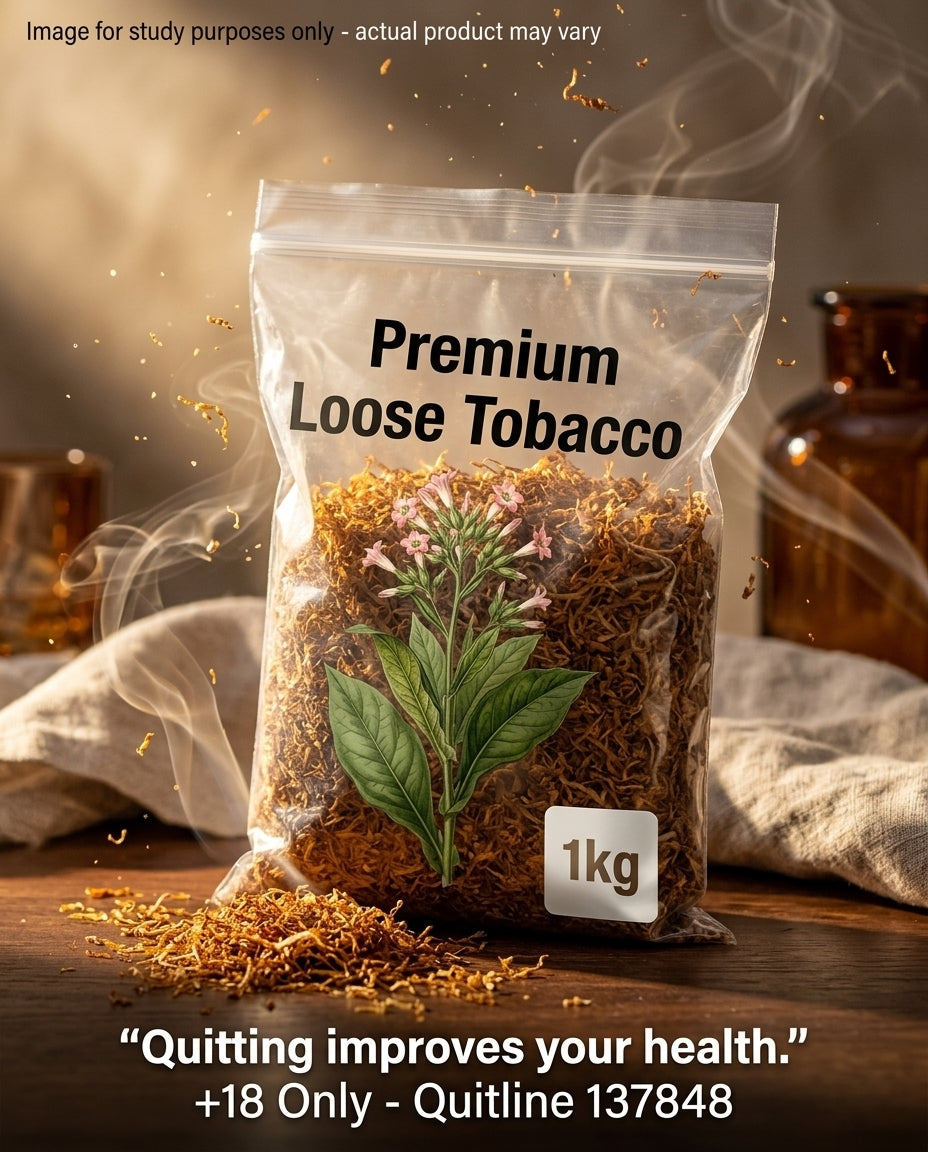
The same logic applies to roll-your-own. For a bagged product, calculate the per-gram value from the bag size, then compare that against the smoking pattern you're buying for. A 500g bag and a 1kg bag may look similar on a website, but the unit economics can be very different once shipping and repeat ordering are included. If you're comparing product ranges, a branded carton like Marlboro Ice Blast Cigarettes shows how carton-based buying is usually presented, 10 packs of 20 cigarettes, or 200 sticks total.
Logistics matter as much as price
Shipping is where many buyers misread the full cost of a deal. A low cart price can stop being attractive once postage, tracking, and handling are added. That's why buyers in the Gold Coast, Perth, or remote regional areas should look closely at dispatch terms, not just the product page.
A useful way to think about delivery is to treat it like any other controlled inventory movement. A delivery-management overview such as the Routelink platform for delivery is a good reminder that tracking, status updates, and handoff control reduce errors. In tobacco buying, the same principle applies, you want a supplier that can show you where the parcel is and when it moved.
The most useful shipping features are practical, not flashy:
- Order tracking: gives you visibility if a parcel stalls.
- Clear dispatch timing: lets you plan stock instead of guessing.
- Discreet packaging: protects privacy without changing the legal duty to ship compliantly.
- Readable shipping policy: tells you what happens if stock is delayed or refused.
For buyers who want a standard shipping reference point, the shipping policy should always be read before ordering. It's boring compared with product pages, but it's where the actual operational terms usually live. In this market, the cheapest carton is only the cheapest carton if it arrives on time, in the right condition, and with no compliance surprises.
Compliance for Resellers and Group Buyers
Once stock is in hand, the legal duty doesn't stop. Resellers and organised group buyers have to think about packaging, advertising limits, age checks, and record-keeping as ongoing obligations, not optional extras. That matters because tobacco compliance failures can create far more cost than the margin on the sale.
From 1 July 2025, all tobacco products must comply with the requirements in the Public Health (Tobacco and Other Products) legislation. The Australian Government's guide says the maximum penalty for contravening tobacco product requirements is up to $660,000 for individuals and $6.6 million for bodies corporate. Those are not theoretical numbers. They show why a reseller can't treat packaging or handling as an afterthought.

The three areas that trip people up
Packaging standards come first. Australian tobacco packaging rules are strict, and any reseller moving stock on needs to keep the product presentation aligned with current legal requirements, including health warnings. If you're breaking cartons down, repackaging, or presenting stock online, that's where mistakes happen quickly.
Marketing and advertising are just as sensitive. Tobacco promotion online is heavily constrained, and businesses that post casually can end up creating the wrong kind of evidence trail. A picture, a caption, or a sales pitch that crosses the line can be more damaging than a stock issue.
Age verification is essential. If you sell to adults, you need systems that effectively prevent minors from buying. For group buyers, that means you still need to think like a retailer if there's any onward distribution involved.
Compliance isn't a paperwork task. It's part of the product.
Record-keeping closes the loop. If a regulator asks where stock came from, who handled it, and how it was sold, vague memory won't help. Keep purchase records, delivery records, and supplier details together from the start. The businesses that stay out of trouble are usually the ones that can prove what happened without scrambling.
Sourcing Alternatives for Small-Scale Buyers
Not everyone needs a wholesale account. A lot of small buyers, regional customers, and adult group purchasers just want bulk-pricing benefits without carrying the licensing and compliance burden that comes with true wholesaling. For them, a compliant online retailer is often the more realistic path, especially in places like Adelaide or Hobart where access and convenience matter as much as unit price.
That's a practical insight often overlooked. Wholesale tobacco sounds cheaper because the unit cost is lower, but the legal overhead can wipe out the advantage if you don't require pallet-level or business-to-business supply. A lawful retailer can still offer carton pricing, bulk RYO options, and delivery without forcing you to operate like a licensed distributor.
If your buying pattern is closer to personal or small-group use, it makes more sense to compare standardised carton formats and bulk tobacco ranges rather than chase a wholesale arrangement you don't need. Product-range guides like loose tobacco brands can help you understand what a compliant retail-oriented offer looks like, without pretending every bulk purchase is a wholesale transaction.
The decision point is simple. If you're reselling, you need to behave like a business and meet the licensing rules. If you're buying for personal use or an informal group, a compliant online retailer is often the cleaner option because it gives you transparent pricing, delivery, and age-gated ordering without the extra administrative load.
Choose the structure that fits the scale of your purchase, not the one that sounds cheapest on a search result. If you want a lawful, straightforward way to compare cartons and bulk tobacco in Australia, visit Cigarette Nearby and review the current catalogue, shipping terms, and age-gated purchasing process before you order.


