





Pick king size for a quicker nicotine hit and the widest availability. Pick superking, often labeled 100s, when you want a longer, slower smoke from a single stick.
- Session length and tobacco per stick: King-size cigarettes run around 84mm and burn faster; 100s stretch to about 100mm and hold more tobacco mass, which tends to mean more puffs and a longer burn per cigarette.
- When each makes sense: King size suits a quick break between tasks; superking suits smokers who want to slow down and stretch out one cigarette rather than lighting a second sooner.
Biomarker research from NHANES has tied longer rod formats to higher cotinine and NNAL levels in some smokers, though behavior plays a role too. Cigarettenearby lists exact rod length and pack specs on every product page, so you can confirm what you’re buying before checkout.
Key Takeaways
Choosing between king size and superking comes down to matching rod length and circumference to your actual smoking habits, not picking based on the name alone.
| Point | Details |
|---|---|
| King size for speed | Around 84mm, fewer puffs, and the fastest option for a quick nicotine hit. |
| Superking/100s for duration | Around 100mm, more puffs, and a longer session per stick. |
| Exposure varies by rod length | NHANES data links longer formats to higher cotinine and NNAL on average. |
| Behavior affects outcomes | Compensatory puffing means format alone doesn’t fix nicotine intake. |
| Check specs before buying | Cigarette Nearby lists exact mm length and gauge on every product page. |
Table of Contents
- King Size vs Superking: What the Labels Actually Mean
- How Does Rod Length Change the Smoking Experience?
- Do Longer Cigarettes Really Mean Higher Exposure?
- Which Format Should You Buy: King Size or Superking?
- What Do Pack Labels Like “100s” Actually Tell You?
- What Cigarette Nearby Recommends for Most Buyers
- Compare Formats and Order the Right Pack
- Frequently Asked Questions
- Sources
King Size vs Superking: What the Labels Actually Mean
King size and superking aren’t marketing fluff. They’re specific length categories that show up in a cigarette’s rod measurement, and once you know the numbers, reading a pack label gets a lot easier.
King size typically measures around 84mm, making it the most common format sold worldwide. Superking, often printed as “100s” on American and Australian packaging, runs closer to 100mm, noticeably longer per stick. Between those two sit a few less common categories: regular or short cigarettes at roughly 68 to 70mm (a format that’s largely disappeared from modern shelves), and extra-long or 120s stretching to 110 to 121mm.
The name “Superkings” itself dates back to the early 1980s, when it was introduced as a lengthened alternative to standard king-size cigarettes, and the term has stuck around long enough that it’s now used almost interchangeably with “100s” in many markets, according to historical brand records.
| Length category | Typical length (mm) | Common pack label |
|---|---|---|
| Regular/short | 68–70 mm | Regular |
| King size | around 84 mm | King, King Size |
| Long/superking | about 100 mm | 100s, Superking, Long |
| Extra-long | 110–121 mm | 120s |
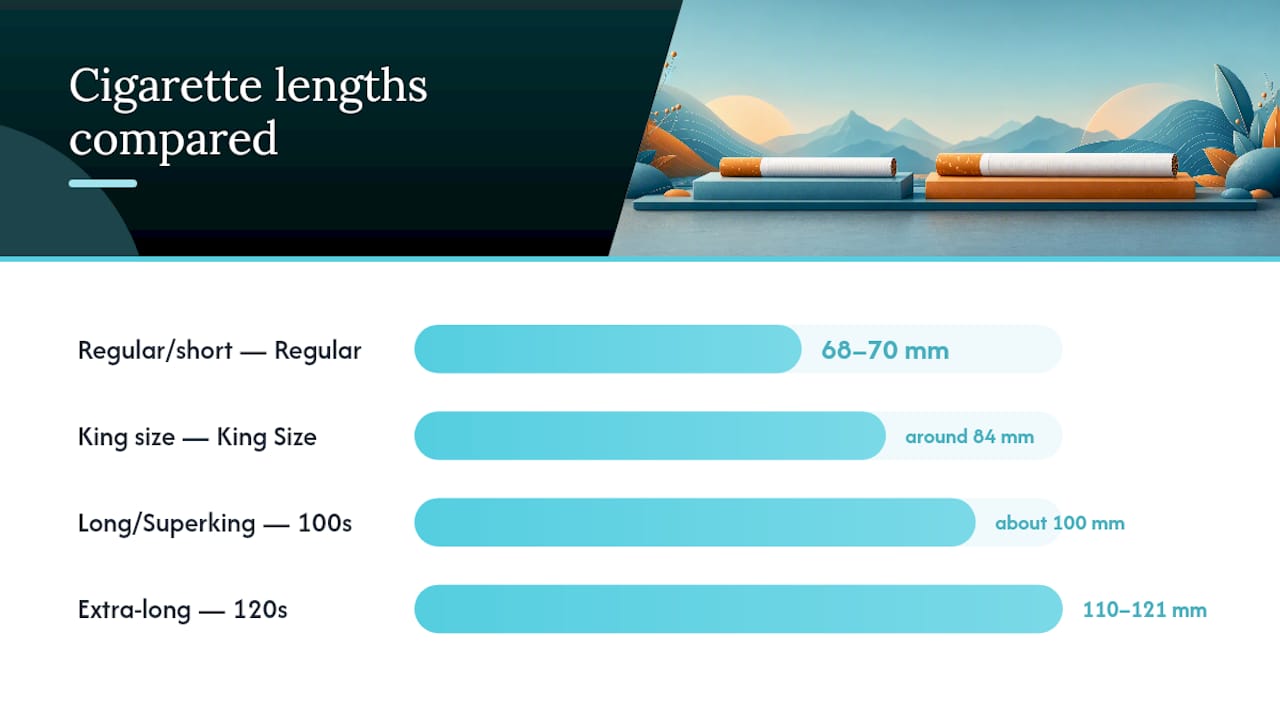
Circumference matters just as much as length. A standard gauge cigarette and a slim or superslim version of the same length can smoke very differently, since a narrower diameter changes how fast air moves through the tobacco column. That affects draw resistance, perceived strength, and how quickly the cigarette burns down. Retail size charts consistently flag this as a separate variable from length, and it’s worth checking both numbers rather than assuming length alone tells the full story.

How Does Rod Length Change the Smoking Experience?
Longer rods mean more puffs and more time spent with a cigarette in hand. King size, being shorter, finishes faster and works well for smokers who want a quick nicotine hit and want to get back to what they were doing. Superking or 100s stretch the session out.
Retail data from cigarette retailers suggests 100s tend to deliver roughly 10 to 20 percent more smoking time than king size, depending on how fast someone smokes. That’s not a massive gap, but for a two-pack-a-day smoker, it adds up across a week.
Circumference complicates the picture further. Superslim cigarettes, generally 17mm or narrower, change smoke velocity through the rod. That can lower some smoke constituents while raising others, including formaldehyde, according to comparative machine-yield studies. So a slim 100 and a standard-gauge 100 aren’t the same experience, even though they share a length category. A related detail worth knowing: a 100s stick generally carries modestly more tobacco mass than a king-size stick of the same blend, and that extra mass can push per-stick nicotine and tar delivery higher even when nothing else about the tobacco changes.
None of this happens in a vacuum, though. Smokers often adjust their puffing pattern, taking deeper or more frequent draws, to reach whatever nicotine level feels normal to them. Compensatory smoking research has documented this pattern repeatedly, which is part of why rod length alone doesn’t perfectly predict how much someone actually takes in. Filter design and ventilation play into that too, a detail covered in more depth in how filter length and ventilation shape perceived smoothness.
- King size: fewer puffs, shorter burn time, faster session.
- Superking/100s: more puffs, longer burn time, extended session.
- Superslim gauge: narrower draw, altered smoke constituent levels regardless of length.
Pro Tip: Buy one pack of king size and one pack of 100s in the same brand, then track puff count and total minutes smoked for each. Most people are surprised by how much the gap actually is once they measure it themselves instead of guessing.
Do Longer Cigarettes Really Mean Higher Exposure?
Yes, on average, according to population-level data, though smoker behavior and tobacco mass both influence the size of that effect.
NHANES analyses comparing regular, king-size, and long or ultralong cigarette smokers found that people who smoked longer formats had higher measures of tobacco dependence, along with higher serum cotinine and urinary NNAL, two biomarkers used to estimate nicotine and carcinogen exposure. That doesn’t mean every superking smoker has higher exposure than every king-size smoker; it means the pattern shows up consistently at the population level.
Long-rod smokers in NHANES data showed measurably higher cotinine and NNAL levels than king-size or regular cigarette smokers, a gap researchers link partly to tobacco mass and partly to smoking behavior.
A separate experimental study reinforces the behavior angle. When long-cigarette smokers were switched to a shorter research cigarette, they showed the largest changes in cigarettes smoked per day and in perceived satisfaction, compared with smokers who normally used shorter formats. That tells you rod length isn’t just a physical spec. It’s tied to how people habitually smoke, and changing the format disrupts that habit measurably.
Mouth-level exposure studies add a third layer. Comparing superslim and conventional circumference cigarettes under lab conditions produced mixed results: superslim sometimes lowered exposure for certain tar bands but raised others, including formaldehyde output, per MLE and part-filter research. None of these findings amount to a simple “one format is safer” conclusion. They show that length, circumference, and individual smoking behavior interact in ways that resist a tidy summary, a nuance worth remembering next time a myth about cigarette formats comes up in conversation.
Which Format Should You Buy: King Size or Superking?
The decision usually comes down to how you smoke, not which format is objectively “better.”
| Feature | King size | Superking/100s |
|---|---|---|
| Length | ~84 mm | ~100 mm |
| Circumference | Standard or slim | Standard or superslim |
| Smoking experience | Quicker session, fewer puffs | Longer session, more puffs |
| Exposure indicators | Generally lower cotinine/NNAL at population level | Generally higher cotinine/NNAL at population level |
| Best for | Quick nicotine hit, frequent short breaks | Leisurely smoke, fewer breaks per day |
| Common pack labels | King, King Size | 100s, Superking, Long |
Run through this quick checklist before you check out:
- Want a fast nicotine hit between tasks? Choose king size.
- Want to stretch out one cigarette and smoke less often overall? Choose superking or 100s.
- Prefer a lighter draw? Look for slim or superslim gauge in either length.
- Smoking mostly in the morning versus winding down at night? Preferences often shift by time of day, so it’s worth trying both formats before settling on one.
Before you buy, check the exact rod length listed on the product page, along with the filter length and tobacco mass if it’s shown. Confirm the pack labeling matches what you expect. A “100s” label should correspond to roughly 100mm, not just a marketing name.
What Do Pack Labels Like “100s” Actually Tell You?
Online listings use a handful of recurring labels: King, King Size, or 84mm for the shorter format, and 100s, Superking, or Long for the longer one. Pack counts are usually standardized at 20 sticks regardless of length, so the label tells you about the cigarette itself, not the pack size.
Regional naming isn’t always consistent. Some markets restrict maximum lengths or set minimum diameters for cigarettes sold at retail, which affects what’s available and how it’s labeled locally, per industry size chart documentation. A “superking” in one market might not match the exact mm spec of a “100s” pack elsewhere.
Pro Tip: Always check the mm length listed on the product spec line before ordering. If it’s missing, look at product photos for scale, or reach out to customer support to confirm before you commit to a carton.
What Cigarette Nearby Recommends for Most Buyers
Most daily smokers do fine with king size as a default, since it’s widely stocked, quick to smoke, and consistent across brands like Marlboro. If you prefer a longer, slower session, 100s are worth the switch. Either way, check the listed specs before buying.
Compare Formats and Order the Right Pack
Cigarettenearby lists exact rod length, circumference, and pack specs on every product page, so you’re not guessing between a “king” and a “100” based on the name alone. That’s the practical edge over browsing generic listings that skip the measurements entirely.

Browse the vendor collection to compare formats across brands including Marlboro and Double Happiness, both stocked in king-size and 100s options. If you want a narrower gauge alongside a longer rod, the superslim menthol listing shows how that combination reads on a real product page. Every order ships with discreet packaging and fast delivery, and customer support is available around the clock if a pack spec still isn’t clear. Head to the top trending collection to see which formats other shoppers are buying right now, then place your order once you’ve confirmed the length and gauge match what you’re after.
Frequently Asked Questions
What’s the actual difference between king size and superking cigarettes? King size runs about 84mm, while superking, often labeled 100s, measures closer to 100mm. The extra length means more tobacco per stick and a longer smoking session.
Is superking the same thing as 100s? Generally yes. “Superking” and “100s” both describe cigarettes around 100mm, though exact naming can vary slightly by region and brand.
Does a longer cigarette mean more nicotine exposure? Population data from NHANES shows smokers of longer formats tend to have higher cotinine and NNAL levels on average, though individual smoking behavior and tobacco mass both play a role.
Why do some superking cigarettes feel lighter than king size? Circumference, not just length, affects draw. A superslim 100 has a narrower diameter than a standard king size, which changes airflow and perceived strength even though it’s a longer stick.
How do I know which format a product page is listing? Check the mm length and circumference directly on the spec line. Labels like “King,” “100s,” or “Superking” should correspond to specific measurements, which Cigarette Nearby lists on every product listing.
This article is general information, not a substitute for advice from a qualified doctor. Consult a qualified healthcare professional about your own circumstances before acting on anything here.
Sources
- Cigarette smoke constituent and exposure differences by rod length (NHANES rod-length analysis)
- Study comparing superslim and conventional circumference cigarettes (machine yields and MLE findings)
Recommended
- Why Some Smokers Prefer Different Cigarettes for Morning vs Night Rout – Cigarette Nearby
- Why More Smokers Explore Multiple Cigarette Brands Instead of Staying – Cigarette Nearby
- Why Some Cigarettes Feel Smoother Than Others — Hidden Details Adult S – Cigarette Nearby
- What Makes a Cigarette Feel “Premium” Beyond Just Price – Cigarette Nearby


