












Every tobacco order and every tobacco licence application in Australia collects identifiable personal data, and licence data can lawfully be shared with police and border agencies under statute. Legitimate retailers collect only what compliance and delivery require. Illicit online sellers offer no such structure, exposing customers to weak payment security, exposed personal data, and the risk of a permanent enforcement record if a parcel is intercepted.
TL;DR:
- Licensed tobacco license applications include extensive personal and business data, which can be shared with law enforcement for compliance and investigation purposes.
- Illicit online sellers avoid formal records, exposing buyers to weak payment security, unprotected personal data, and increased risk of enforcement action or border seizure.
- Buyers can reduce privacy risks by choosing retailers with clear privacy policies, using secure payment methods, and shipping to addresses they control.
- Unlicensed sellers often lack a privacy policy, require informal payment options, and may have vague claims about customs clearance, raising red flags.
- Data breaches involving licensed sellers pose lower risks, as exposure could lead to fraud or enforcement scrutiny, whereas illicit seller breaches have unpredictable and severe consequences.
Table of Contents
- What personal information do licensing schemes and legitimate retailers actually collect?
- How can licence and application data be used and shared by government?
- Which online sellers put your privacy at risk, and how do you spot them?
- How do you protect your privacy when ordering tobacco or applying for a licence?
- Product comparison: choosing privacy-conscious tobacco and cigarette options
- How does tobacco advertising tracking connect to your purchase data?
- What role do privacy laws play in tobacco order confidentiality?
- What happens if your tobacco order data is exposed or breached?
- Why we recommend licensed channels over privacy shortcuts
- Buy cigarettes online with the privacy standard this article describes
- Smoker FAQs
- Sources
What personal information do licensing schemes and legitimate retailers actually collect?
Tobacco is one of the more heavily documented retail categories in Australia, and that starts well before a delivery van reaches your door. Anyone applying for a tobacco seller’s licence in a state like New South Wales hands over a substantial personal and business file. Anyone placing an order with a legitimate retailer hands over a smaller, transaction-specific set.
For licensing, the fields typically include:
- Full name, date of birth, and residential address
- ABN and business structure details for the entity applying
- Certified identity documents (licence, passport, or similar)
- Declarations naming any “relevant person” connected to the business
- Consent to criminal history and compliance checks
Service NSW’s own privacy collection notice for the tobacco licensing scheme confirms the Ministry of Health and Service NSW collect exactly this kind of identity, business, and licence information to assess eligibility and manage ongoing compliance.
Retail orders ask for far less: your name, delivery address, email, phone number, and a tokenised payment reference rather than a stored card number. Wholesalers sit at the other end of the spectrum again, retaining invoices and excise documentation for years because the Australian Taxation Office requires an audit trail on every dutiable tobacco transaction. Each data point exists for a reason: age and eligibility verification, excise compliance, physical delivery, or fraud prevention. None of it is collected out of curiosity.
How can licence and application data be used and shared by government?
This is where discreet cigarette purchases and licence applications diverge from an ordinary retail transaction. A standard purchase from a supermarket generates almost no lasting record. A licence application generates a file that can travel between agencies.
Service NSW and NSW Health can disclose licence-related information to other government bodies and to law enforcement where the Public Health (Tobacco and Other Products) Act 2023 and related state legislation permit it. In practice, that sharing serves specific purposes:
- Eligibility and probity checks, including criminal record screening
- Enforcement action against unlicensed sale or supply
- Cross-jurisdictional compliance, where NSW Police, the AFP, or the Australian Border Force need applicant details tied to a broader investigation
Applicants sometimes assume a licence file is private once submitted. It isn’t. Sensitive collection, including criminal record checks and disclosure to law enforcement, is a built-in feature of a regulated licensing scheme, not an exception to it.
The practical consequences follow from that structure. An applicant with an incomplete police check faces delays. One with a disqualifying history faces refusal. An existing licence holder found non-compliant can have it revoked, usually after a formal notice process that itself creates another documented record.
Which online sellers put your privacy at risk, and how do you spot them?
Licensed retailers operate inside a paper trail on purpose. Illicit sellers avoid one on purpose, and that difference is the single biggest privacy hazard in online tobacco shopping.
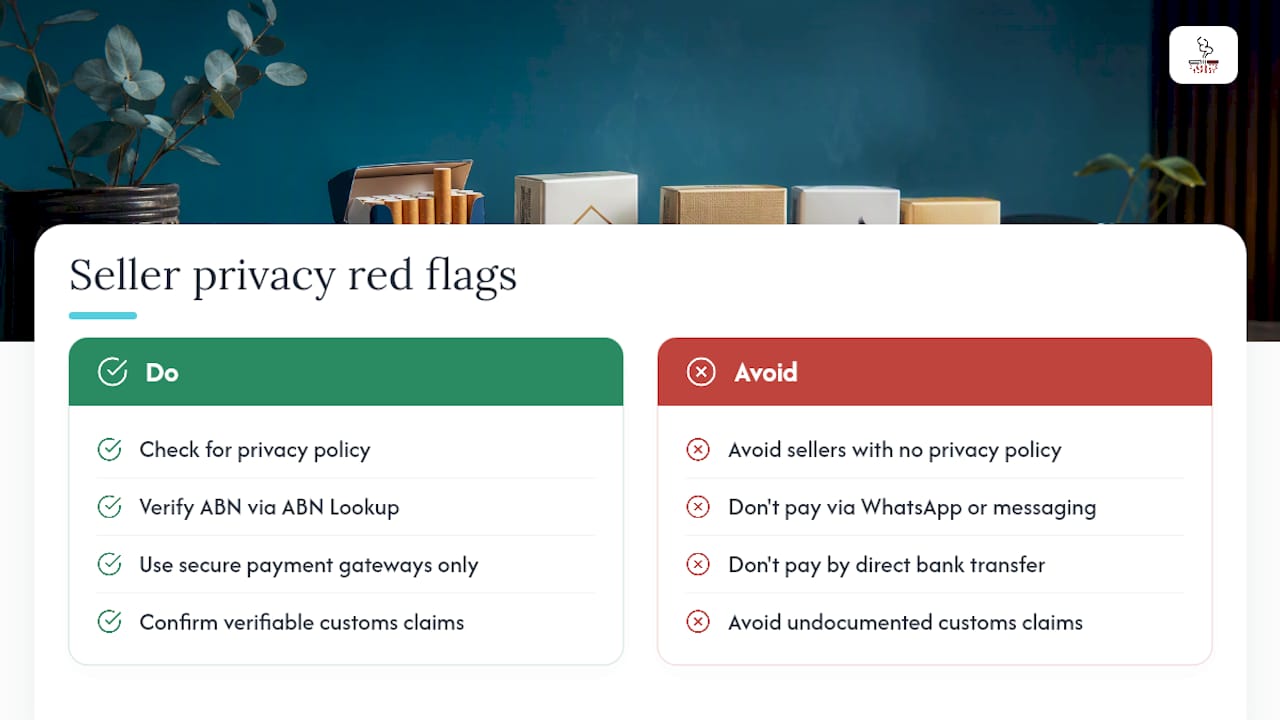
Reporting on the growth of Australia’s black market for tobacco has documented a consistent operating pattern among unlicensed sellers: direct bank transfers instead of secure gateways, contact conducted over WhatsApp rather than a monitored support channel, and no published privacy policy at all. None of that is incidental. A seller with no privacy statement has made no commitment about how your name, address, and bank details are stored, who can access them, or how long they’re kept.
The border adds a second layer of exposure. Tobacco products are prohibited from international mail, and the Australian Border Force is explicit that approved imports must move through air or sea cargo with a traceable waybill, not the postal stream. A parcel sent by international post is liable to seizure, and that seizure creates a record tied to your name and address, not a quietly discarded envelope.
Three key red flags to check before you order are: absence of a privacy policy or ABN on the website, requiring payment by direct bank transfer, cryptocurrency, or informal messaging apps, and vague or unverifiable claims about customs clearance for imported stock.
Pro Tip: Search the seller’s business name plus “ABN Lookup” before you pay. A legitimate Australian retailer will show up on the Australian Business Register in seconds; an illicit one usually won’t.
How do you protect your privacy when ordering tobacco or applying for a licence?
You can’t opt out of the data a licensing scheme legally requires. You can control almost everything else, and that’s where most of the actual privacy risk sits.
For individual buyers, four habits do most of the work:
- Buy only from retailers that publish a clear privacy policy and an ABN
- Use secure, tokenised payment gateways rather than direct transfers
- Avoid saving payment details on any site you don’t order from repeatedly
- Ship to an address you control, so a delivery record doesn’t sit with a third party
For businesses handling tobacco orders or licence data, the Australian Privacy Principles set the baseline: collect only what’s needed, retain payment data for the shortest defensible period, and publish a privacy collection notice that says plainly what’s gathered and why. Retail privacy policies, including the kind published by industry bodies like the Tobacco Industry Observatory, typically cover what counts as personal information, when it’s disclosed to third parties, and how a customer can access or correct their own record.
If you think a retailer or agency mishandled your data, you have a formal path. You can request access to what’s held about you, ask for correction of inaccurate details, and if that gets nowhere, lodge a complaint with the Office of the Australian Information Commissioner. Businesses that buy stock for resale should also read up on wholesale tobacco licensing and supplier documentation before assuming any supplier relationship is privacy-neutral. It rarely is.
Product comparison: choosing privacy-conscious tobacco and cigarette options
Buying tobacco online privately starts with choosing a retailer that treats discreet shipping and secure checkout as standard, not as an upsell. CigaretteNearby’s catalogue spans loose tobacco and packaged cigarettes at a range of pack sizes, so bulk buyers and single-pack shoppers get the same fulfilment standard.
- Premium Loose Tobacco 500g (Resealable Bag) — a rich, natural blend at a cheap bulk price with fast delivery Australia-wide, suited to smokers rolling their own on a regular basis.
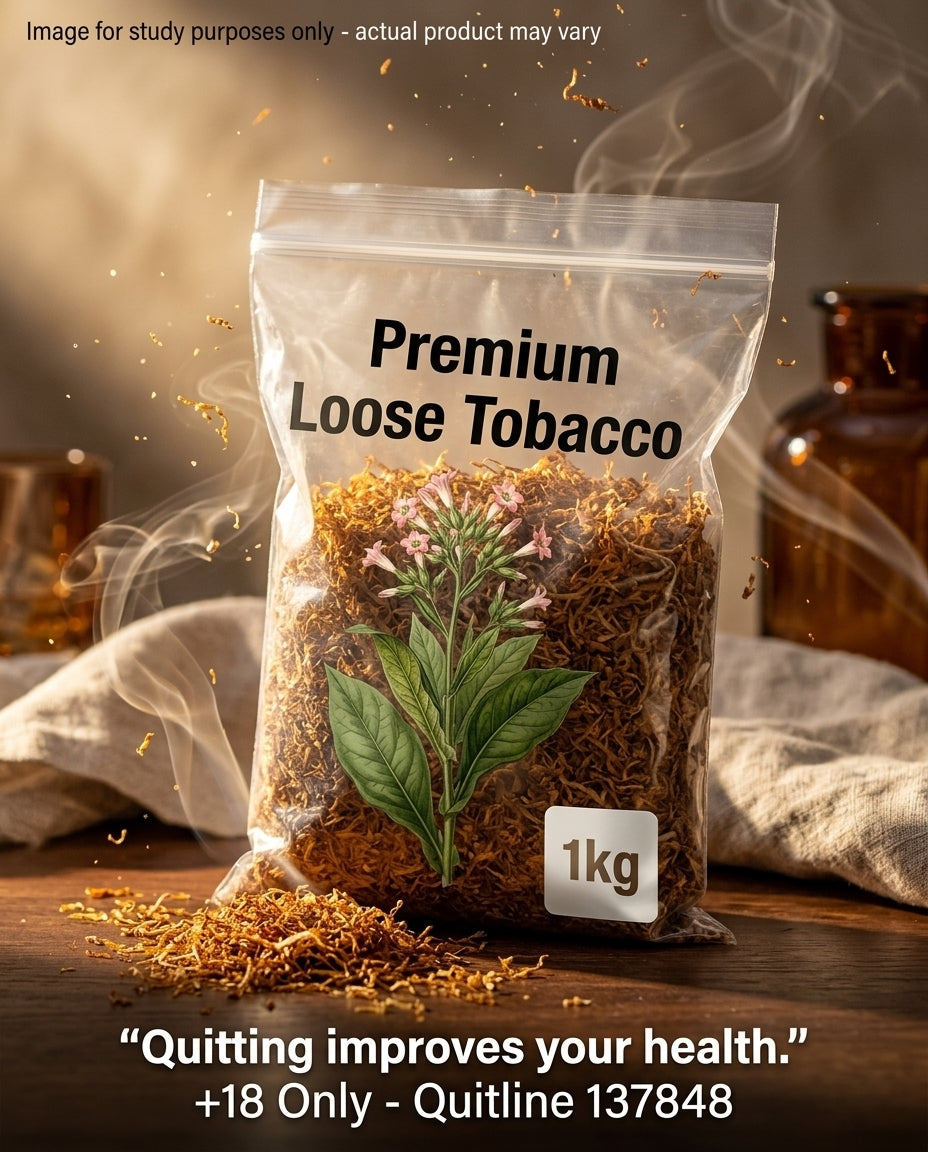
- Premium Loose Tobacco 1kg (Resealable Bag) — deep natural tobacco character with affordable bulk pricing, delivered to your door for households or small retailers buying ahead.
- Golden Virginia Japanese 500g Premium Loose Tobacco — a fine-cut, smooth blend at cheap bulk price with nationwide dispatch.
- Golden Virginia Japanese 100g Premium Loose Tobacco — the same smooth fine-cut blend in a smaller format, priced for best value online with fast delivery Australia-wide.
- Manchester Superslims Chocolate Cigarettes (10 Packs x 20s) — a light cocoa aroma in a slim style, buy online for best value with fast delivery Australia-wide.
- Manchester Classic Blue Plain Package Cigarettes 20s (10 Packs) — a smooth everyday tobacco with affordable carton delivery.
- Esse Change Cigarettes (10 packets x 20s) — a dual capsule menthol slim design, buy online cheap with fast delivery to your door.
- Manchester Slim Double Apple Cigarettes (10 Packs x 20s) — light aromatic freshness, order online for best value with discreet shipping.
How does tobacco advertising tracking connect to your purchase data?
Buying tobacco online, even from a fully compliant retailer, can generate marketing data that outlives the transaction. Retargeting pixels, email capture at checkout, and loyalty programs all create a secondary data trail separate from the licence and delivery records already discussed.
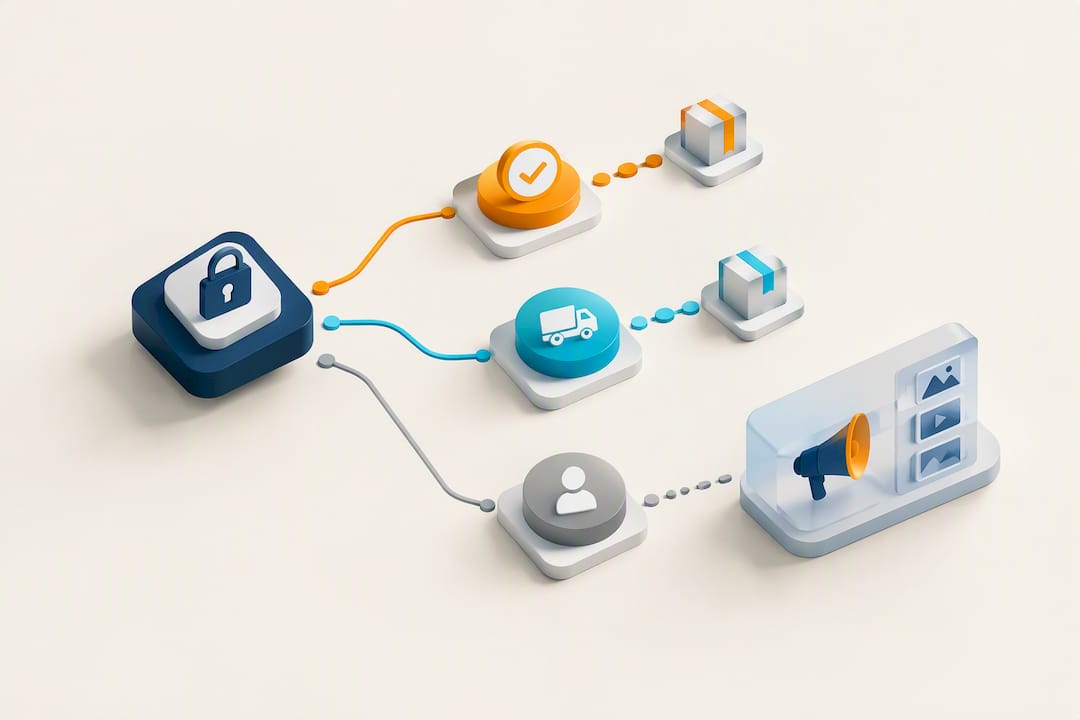
Australia’s advertising restrictions on tobacco are strict, which pushes some of that tracking into less visible channels: retention emails, SMS reminders, or programmatic ad targeting based on past purchase categories rather than an explicit “cigarette ad” a regulator would flag immediately. If a retailer’s checkout page shares your email with a third-party ad platform for lookalike targeting, that’s a real expansion of who holds your purchase history, even though no cigarette brand ever appears in the ad itself.
The fix is procedural, not technical. Check whether a retailer’s privacy policy discloses third-party marketing use before you tick the checkout box, and unsubscribe from post-purchase marketing if you’d rather your buying pattern didn’t feed a profile. A retailer that only uses your email for order confirmations and delivery updates, and says so plainly, is a materially lower privacy risk than one that stays vague about “improving your experience.”
What role do privacy laws play in tobacco order confidentiality?
Australia doesn’t have a GDPR-style single privacy regime, but the Australian Privacy Principles under the Privacy Act 1988 set out comparable obligations for any organisation handling personal information, tobacco retailers included. The 13 APPs cover collection, use, disclosure, storage security, and the right to access or correct your own record, and they apply whether the seller is a big retailer or a small licensed tobacconist trading online.
Where tobacco specifically diverges from ordinary retail is the added layer of public health legislation. The Public Health (Tobacco and Other Products) Act 2023 sits alongside the APPs and adds reporting obligations to health authorities that most consumer goods never trigger, while the earlier Public Health (Tobacco) Act 2008 still underpins several state-level licensing and advertising restrictions. That combination means your tobacco order sits under two overlapping frameworks at once: general privacy law governing how a business handles your details, and public health law governing what the business itself must report about tobacco sales.
For an Australian buyer, the practical upshot is that a licensed retailer has genuine legal accountability for your data. An offshore or unlicensed seller usually has none, because Australian privacy law is hard to enforce against an entity with no local presence.
What happens if your tobacco order data is exposed or breached?
A privacy breach tied to a tobacco order isn’t a hypothetical inconvenience. It carries two distinct risks that other retail breaches often don’t.
The first is identity theft, same as any data breach: exposed name, address, and payment details can be used for fraud regardless of what was purchased. The second is specific to this category. A leaked or seized record showing you bought tobacco from an illicit source can draw enforcement attention, since border interception of a prohibited parcel creates a traceable record tied to the consignee, not a private, forgettable event. Background reporting on the illicit market also notes that customers of unlicensed sellers can have their data become a target for broader criminal investigations, given the informal payment and contact channels those sellers rely on.
That’s a meaningfully different risk profile from buying a jumper online and having your card details leaked. It’s the reason a lawful, documented purchase trail, even with its administrative overhead, is generally the lower-risk path. Recordkeeping from a licensed retailer is expected and bounded by law. Data exposure from an illicit one has no such limits and no consumer protections attached to it at all.
Why we recommend licensed channels over privacy shortcuts
We’ve looked at hundreds of tobacco licensing files and retail privacy notices over the years, and the pattern is consistent: the sellers with the most thorough privacy policies are almost always the ones with the least to hide operationally. That’s not a coincidence. A licensed retailer publishing a clear privacy statement has already accepted regulatory oversight, so transparency costs it nothing extra.
The instinct to seek out an unlicensed seller because it seems more discreet is, in our view, backwards. Lawful purchases carry expected recordkeeping. Illicit ones carry unpredictable exposure, no consumer protections, and a real chance of a permanent enforcement record if a parcel gets flagged at the border. If you’re unsure what a retailer collects or shares, read its privacy notice before you order, and contact its support line if anything is unclear.
— Cigarette Online
Buy cigarettes online with the privacy standard this article describes
This retailer offers adult smokers prices that reflect bulk buying along with discreet delivery. Orders run through secure, tokenised payment, every order ships in discreet packaging, and support is available for anything from a delivery query to a privacy question about your order.
That’s the practical contrast this whole explainer has been building toward: a lawful paper trail you can actually see, versus the unpredictable exposure of a seller with no privacy policy at all. Whether you’re after loose tobacco in bulk or a carton of your regular pack, browse the cigarettes collection or the tobacco collection and place an order through a checkout built around the standards this article describes.
Smoker FAQs
Is it illegal to buy tobacco online in Australia?
Buying tobacco online from a licensed Australian retailer is legal. What’s restricted is importing tobacco through international mail, which the Australian Border Force prohibits, and buying from unlicensed sellers operating outside state licensing rules.
What is considered a breach of privacy?
A privacy breach happens when personal information, like your name, address, or payment details, is accessed, disclosed, or lost without proper authorisation. For a tobacco order, that could mean a retailer sharing your data with an undisclosed third party or an unsecured payment system exposing your card details.
Can I send cigarettes in the mail in Australia?
No. Tobacco products are prohibited in the international mail stream, and approved imports must move through air or sea cargo with a traceable waybill, according to the Australian Border Force. Domestic delivery from a licensed Australian retailer isn’t subject to this restriction.
Is it safe to order cigarettes online?
Ordering from a licensed retailer with a published privacy policy, secure payment gateway, and discreet packaging is a low-risk transaction. The main danger comes from unlicensed sellers using informal payment methods and no privacy safeguards, which is where most of the real exposure sits.
What does CigaretteNearby charge for tobacco and cigarette products?
Current prices for individual products, including pack sizes and bulk tobacco options, are listed on the cigarettes and tobacco collection pages, since pricing varies by product and quantity.
Sources
- Tobacco licensing scheme – Privacy collection notice | Service NSW
- Privacy and your personal information: Public Health (Tobacco and Other Products) Act 2023 | Australian Government Department of Health
- The difference between air or sea cargo and international mail | Australian Border Force
Recommended
- Tasmania Tobacco Guide: Why Many Regional and Remote Areas Have Limited Tobacconist Options
- Wholesale Tobacco Australia: Licensing & Suppliers 2026
- Cigarette in Australia: Complete Guide for Adult Smokers 2026
Online Cigarette Nearby provides articles for general information only and may not offer professional advice. Some content is intended for adults aged 18+ only. Help quitting smoking, contact your local Quitline.


