













Chop-chop tobacco sold online in Australia is illicit, untaxed, and risky. The ATO had recorded 194 seizures by 31 May 2026, with 498,841 kilograms destroyed in total and $822 million in excise duty at risk, so the sensible choice for adult smokers is to buy sealed, branded RYO tobacco from age-verified Australian online retailers instead of chasing a shortcut that can turn expensive fast.
The cheapest listing usually looks clever right up until you count the actual cost. Once you add legal exposure, product uncertainty, and supply disruption, the bargain starts to look thin, especially in a market where the official numbers show the illicit supply chain is still large and active ATO illicit tobacco data.
Table of Contents
- Why the Cheapest Listing Is Rarely the Smartest Buy
- What Chop-Chop Means in the Australian Context
- Australian Legal Status and Real Penalties
- Health and Quality Risks You Cannot See in a Bag
- How Legal Bulk RYO Beats Chop Chop on Real Value
- Buying Legal RYO Online the Right Way
- Your Safer Buying Checklist and What to Do Next
Why the Cheapest Listing Is Rarely the Smartest Buy
The temptation behind chop chop tobacco online is easy to understand. If a listing looks far cheaper than taxed cigarettes or branded pouches, it feels like a shortcut to the same outcome. In Australia, though, the question is not just what the bag costs, it's what the purchase exposes you to after checkout.
The cost includes more than money
The ATO's own enforcement figures show this is not a fringe issue. By 31 May 2026, it had recorded 194 seizures of illicit tobacco and $822 million in excise duty at risk across the reported period, with 2023-24 alone showing 81 seizures, 16,687 kilograms seized and destroyed, 13,382,445 cigarettes, and $45 million in estimated excise duty ATO illicit tobacco data.
That matters because illicit tobacco is not a normal retail category. It is untaxed supply, so there's no excise verification, no regulated manufacturing control, and no reliable age-compliance assurance. If a listing is built around being cheap, the price is usually hiding risk, not efficiency.
Practical rule: if a tobacco offer depends on secrecy, unmarked packaging, or a vague seller identity, the discount is doing too much work.
What buyers usually miss
Searching for a bargain typically involves comparing sticker prices and stopping there. That's the wrong benchmark. With illicit supply, you're also buying uncertainty about provenance, storage, composition, and whether the product will even be available again next week.
Australian consumer behaviour around tobacco is strongly price-driven, but the safer comparison is lawful bulk RYO, where the product is sealed, branded, and sold through a compliant retailer. If you're trying to find better value without only looking at price, a useful starting point is this guide to comparing value beyond the headline figure, how to find better cigarette value without only looking at price.
The bottom line is simple. The cheap listing is rarely cheap once you include the legal and practical downside. A legitimate bulk purchase can give you a clearer, safer benchmark per gram, with none of the uncertainty that comes with unregulated tobacco.
What Chop-Chop Means in the Australian Context
In Australia, chop-chop is slang for untaxed, illicit loose tobacco. It is often described as black-market tobacco and, in practice, it is the opposite of a factory-sealed branded RYO pouch. The distinction matters because a legal tobacco product is traceable, regulated, and sold with the usual compliance controls, while chop-chop is not.

Loose tobacco is not the same thing as illicit tobacco
People sometimes confuse “loose tobacco” with “chop-chop” because both can be sold in bags. That is where the mistake starts. Legal loose tobacco comes in branded, sealed packaging from a known manufacturer, while chop-chop is generally sold without the same verification or accountability.
A useful way to frame it is status, not shape. A bag of leaf is not automatically illegal, but if it is untaxed or otherwise non-compliant, it sits outside the legal supply chain. That means no excise verification, no quality oversight, and no guarantee that the seller has followed Australian rules. For a clearer look at legitimate product types, see loose tobacco brands sold through compliant retail channels.
Why the term keeps showing up in Australian market data
The scale is not trivial. Australian materials citing a KPMG-based estimate put illicit tobacco at 16.9% of total tobacco consumption in 2020, with $2.9 billion in lost excise revenue. Earlier Australian estimates also described about 864 tonnes of chop-chop sold each year, around 40% of the 2,150-tonne legal loose-tobacco market, with the ATO seizing 117 tonnes in the previous year referenced in that source Victorian parliament tobacco paper.
Those figures show why regulators treat chop-chop as a supply-chain problem, not a product line. If you are looking at a listing and it feels too unstructured to be a proper retail item, that is usually because it is. Branded RYO like Drum or Golden Virginia is sold as a recognised product, while chop-chop is a status problem wrapped in a bag.
Simple test: if you cannot tell who manufactured it, who imported it, and whether it was taxed, you are not looking at a legitimate retail tobacco product.
One example from the broader market is Drum Blue Japanese 500g Premium Loose Tobacco, Rich Balanced Rolling Blend, Cheap Bulk Carton Price, Nationwide Dispatch. Whatever brand a buyer prefers, the key point is the same. A lawful product is identifiable and sealed. Chop-chop is not.
Australian Legal Status and Real Penalties
Australian law treats illicit tobacco as an enforcement issue, not a labelling mistake. At the federal level, tobacco excise and customs rules sit behind the tax system. At the state level, tobacco control laws create separate offences and penalties for possession, sale, and supply. That is why online listings for chop-chop tobacco online can create exposure in more than one direction at once.
Federal enforcement is active, not theoretical
The ATO's 2023-24 reporting makes the scale plain. It recorded 81 seizures, 16,687 kilograms seized and destroyed, 13,382,445 cigarettes, and $45 million in estimated excise duty at risk ATO illicit tobacco data. Those are active enforcement numbers, and they show how seriously the federal system treats supply, storage, and sale.
A common misunderstanding is that casual-looking sellers create a smaller risk. They do not. If the product is uncustomed or illicit, the exposure sits in the supply chain and with the person deciding to buy it. Regulators keep watching online ads, under-the-counter offers, and suspicious stock movement because those patterns often point to the same thing.
For buyers trying to compare legitimate wholesale supply with grey-market offers, the right benchmark is a compliant product trail. A practical overview of that difference is set out in wholesale tobacco Australia guidance, which is useful because lawful stock has a clear origin, sealed packaging, and a verifiable retail path.
Queensland shows what state-level action looks like
Queensland's parliament has been examining a Tobacco and Other Smoking Products bill aimed at dismantling illegal trade, and ABC reporting on the July 2024 Queensland raids described seizures of almost 500,000 black-market cigarettes and 380 kg of chop-chop. That same report said businesses caught in possession or selling illicit tobacco or nicotine products could face fines of up to AUD 322,600, and individuals could face up to two years' imprisonment under the amendment bill introduced the previous month Queensland parliament paper.
The interstate picture still matters
Sydney, Melbourne, Perth, Adelaide, and regional buyers face different state rules, but the practical message does not change. NSW, Victoria, and Western Australia all operate in the same broad enforcement environment, where possession and sale of illicit tobacco can trigger penalties, seizure, and follow-up investigation. Buyers sometimes assume a remote order feels safer because nobody is watching, but online tobacco supply is exactly the kind of activity regulators keep tracking.
The safest assumption is the blunt one. If it looks like a tax-free tobacco workaround, it is probably sitting in the enforcement zone.
For adult smokers, the legal path is easier to defend. Buy sealed, branded tobacco through a compliant retailer, keep your records, and stay out of the supply chain that authorities are already targeting.
Health and Quality Risks You Cannot See in a Bag
Illicit tobacco is a health issue as much as a legal one. The problem is simple, there's no regulated manufacturing process standing behind the bag, so the buyer can't verify what's in it, how it was stored, or whether it was contaminated before sale.
Unknown provenance creates real product risk
Australian public-health materials and state submissions describe illicit tobacco as unregulated and potentially contaminated, with concerns around fungal infection and respiratory conditions. That lines up with the basic reality of chop-chop. If the leaf hasn't passed through a licensed supply chain, there's no reliable check on moisture, mould, pesticide residue, or consistency of the cut.
That uncertainty affects the smoking experience too. A loose bag with unknown storage history can burn unevenly, feel harsher, or vary from one purchase to the next. For smokers in regional areas such as the Sunshine Coast, Hobart, or the Central Coast, that inconsistency is especially frustrating because there's less room to inspect the product in person before money changes hands.
Why regulated products behave more predictably
Factory-sealed RYO products are built for repeatable handling. They're packaged under brand control, so moisture and cut are far more consistent than in an unmarked bag. That doesn't make legal tobacco harmless, but it does make it more predictable, and predictability is part of value when someone is buying for daily use.
A useful reference point for product composition and tobacco format is this overview of contents of cigarettes. Even without getting technical, the core point is clear. Once the seller steps outside regulated packaging and tracing, the buyer loses accountability.
Practical rule: if there's no visible brand structure, no batch logic, and no proper packaging, don't assume the contents are stable just because the bag looks full.
That's why the convenience argument falls apart. The unmarked bag may be easy to buy, but it leaves you with no meaningful recourse if the tobacco is stale, contaminated, or poor quality. A lawful sealed pouch is the safer choice because it gives you a known product, not a guess.
How Legal Bulk RYO Beats Chop Chop on Real Value
Legal bulk RYO wins when you stop comparing it to the sticker price of illicit tobacco and start comparing delivered cost per gram. On that measure, the lawful route is often more competitive than people expect, especially when shipping is included.
The unit price tells the real story
Independent Australian retail listings show how bulk sizing changes the arithmetic. One AU listing shows A$180 per 500 g and A$330 per 1,000 g, while another shows A$246 per 500 g with delivery in 2 to 4 business days Australian chop-chop retail listing. That works out to roughly A$0.36/g versus A$0.246/g, so the larger pack reduces unit cost by about 32% in that example.
That's the useful lesson for lawful buying too. Bigger packs usually lower the per-gram price, which is why 1 kg formats can make more sense for regular users than smaller pouches. If you smoke consistently, the question isn't whether 1 kg looks expensive at checkout. It's whether the delivered unit cost is lower over time.
Shipping can change the answer
Flat-fee shipping and free-shipping thresholds matter because they can move the final delivered cost quite a lot. A bargain pack that needs a separate delivery charge can end up worse value than a slightly dearer pack with better shipping terms. That's why serious buyers should compare delivered unit price, not headline product price.
A lawful bulk purchase also gives you stability. You know what you're getting, you know the packaging standard, and you know the seller has to support the sale as a proper retail transaction. That makes a bigger difference for regular buyers than it does for occasional ones.
| Legal Bulk RYO Format Comparison | Typical Pack Weight | Indicative Per-Gram Range | Best Use Case | Storage Notes |
|---|---|---|---|---|
| Smaller bulk pouch | 500 g | Around A$0.36/g in one listed example | Testing a blend before committing | Keep sealed and away from heat |
| Larger bulk bag | 1 kg | Around A$0.246/g in one listed example | Regular use and lower unit cost | Resealable packaging helps freshness |
The lawful bulk path is the stronger deal
Branded bulk RYO gives buyers a legitimate way to keep costs in check without stepping into the enforcement zone. Brands such as Drum Blue Japanese and Golden Virginia are useful references because they're sold as sealed products with defined formats, not anonymous leaf in a bag. For buyers in Sydney, Melbourne, Brisbane, Perth, Adelaide, and regional centres, that's the more defensible way to chase value.
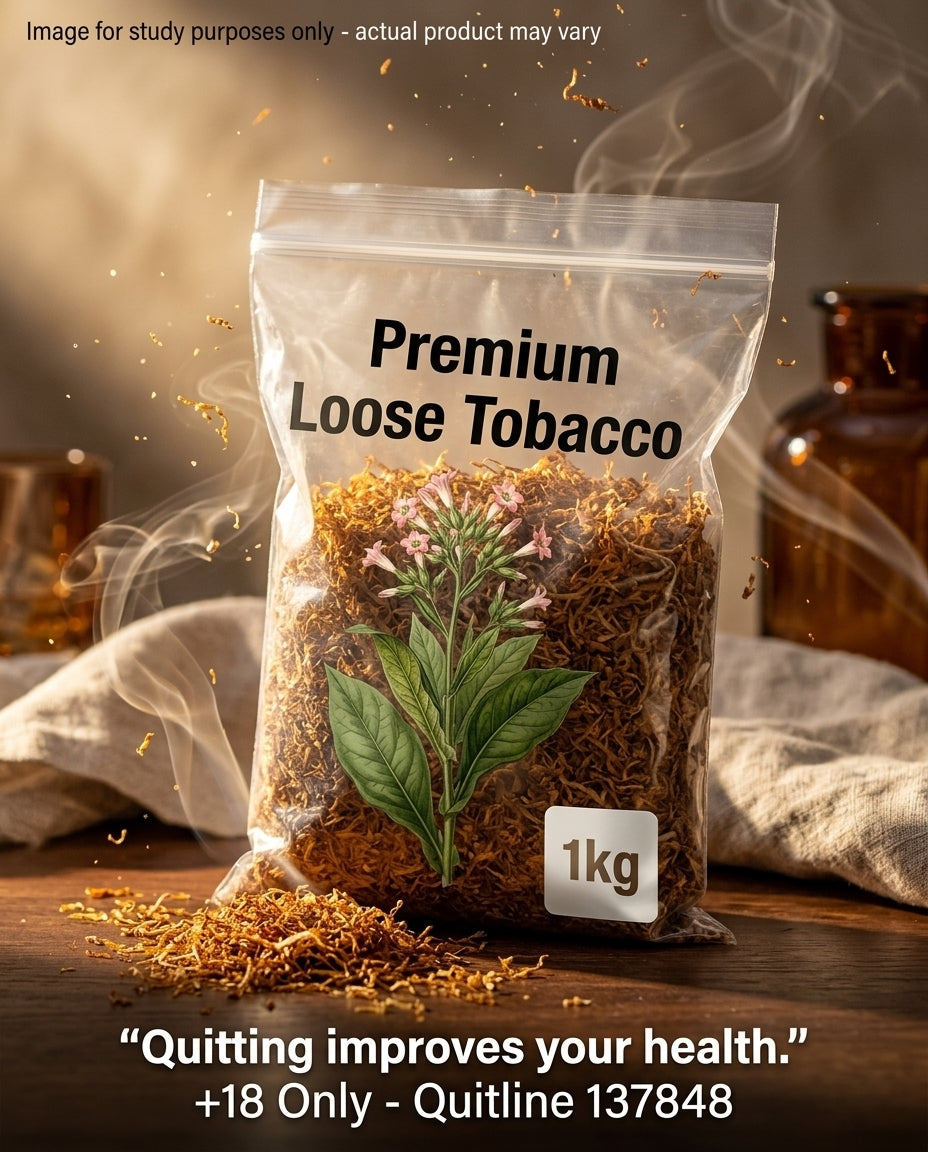
One practical option in the lawful market is Premium Loose Tobacco 1kg (Resealable Bag), Deep Natural Tobacco Character, Affordable Bulk Pricing, Delivered to Your Door. It illustrates the kind of sealed bulk format adult buyers compare when they want lower unit cost without the chop-chop risk.
Buying Legal RYO Online the Right Way
A legitimate online tobacco store should look organised, not mysterious. The checkout should make it obvious that the retailer is dealing with adult customers, the product pages should show what's being sold, and the shipping and policy pages should be easy to find before you pay.
Trust signals that should be visible
Start with the basics. A compliant site should have 18+ age verification, visible Quitline 137 848 and quit.org.au references, clear shipping windows, secure payment, and published refund, terms, and privacy pages. If those pieces are missing or buried, that's a warning sign.
Look at the product page itself too. Good listings should state the blend type, cut style, strength, origin, and whether the packaging is factory-sealed. If the seller won't explain whether a pouch is a Japanese-market edition, a Virginia blend, or a fine-cut rolling tobacco, they're not giving you enough to judge the purchase properly.
What to check before you click pay
- Age gating: make sure the site blocks entry or checkout until you confirm you're an adult.
- Packaging details: look for factory-sealed pouches, printed branding, and batch or production information.
- Shipping transparency: a stated dispatch window such as 2 to 5 business days is far better than vague promises.
- Payment clarity: secure checkout and traceable payment methods matter if you ever need support.
- Policy pages: refund, terms, and privacy pages should be visible before purchase.
For buyers in Sydney, Parramatta, Newcastle, Wollongong, the Central Coast, Melbourne, Brisbane, the Gold Coast, Perth, Adelaide, Canberra, Hobart, and the Sunshine Coast, the experience should feel the same. You place the order, confirm your age, receive dispatch details, and wait for a discreet parcel. That's the normal flow for lawful online buying.
A simple example of what compliant buying looks like
A sealed pouch listing such as Drum Blue 100 g or 500 g should tell you enough to compare like for like, not force you to guess. If you want a broader guide to legal bulk options and delivery expectations, this retailer resource on buying premium loose tobacco online with affordable 500 g and 1 kg bulk bags shows the kind of information a proper store should publish.
Your Safer Buying Checklist and What to Do Next
Keep the decision simple. Choose the option that gives you traceability, not just a lower headline price.

A short checklist that actually helps
- Retailer has clear age verification. If you can enter the store without confirming you're an adult, walk away.
- Product lists Australian customs or excise details. A legitimate listing should look like a proper retail product, not an anonymous bag.
- Website provides an ABN or physical Australian address. If there's no traceable business identity, that's a problem.
- Payment is via a secure, traceable method. Avoid anything that feels cash-like, hidden, or hard to dispute.
If a listing matches the ATO's red flags, such as suspicious online ads, black plastic bags, or “cheap cigarettes” sold under the counter, don't engage. The enforcement environment is active, the health risks are real, and the product uncertainty is unnecessary. If you're thinking about quitting, a quick call to Quitline 137 848 can point you to support without judgement.
For readers who also manage payment exposure in their businesses or side projects, the broader logic is the same as the guidance in 2026 payment risk strategies. Traceable, compliant transactions are easier to defend than risky shortcuts.
Cigarette Nearby publishes age-gated tobacco product information, bulk RYO format details, and Australia-wide delivery guidance for adult buyers who want a lawful path instead of an illicit one. If you're comparing sealed, branded options and want a clearer view of what's available, visit Cigarette Nearby and review the product pages, shipping terms, and health notices before you order.


